Petrányi Zsolt's speech at the exhibition of Endre KoroncziPetrányi Zsolt beszéde Koronczi Endre kiállításán
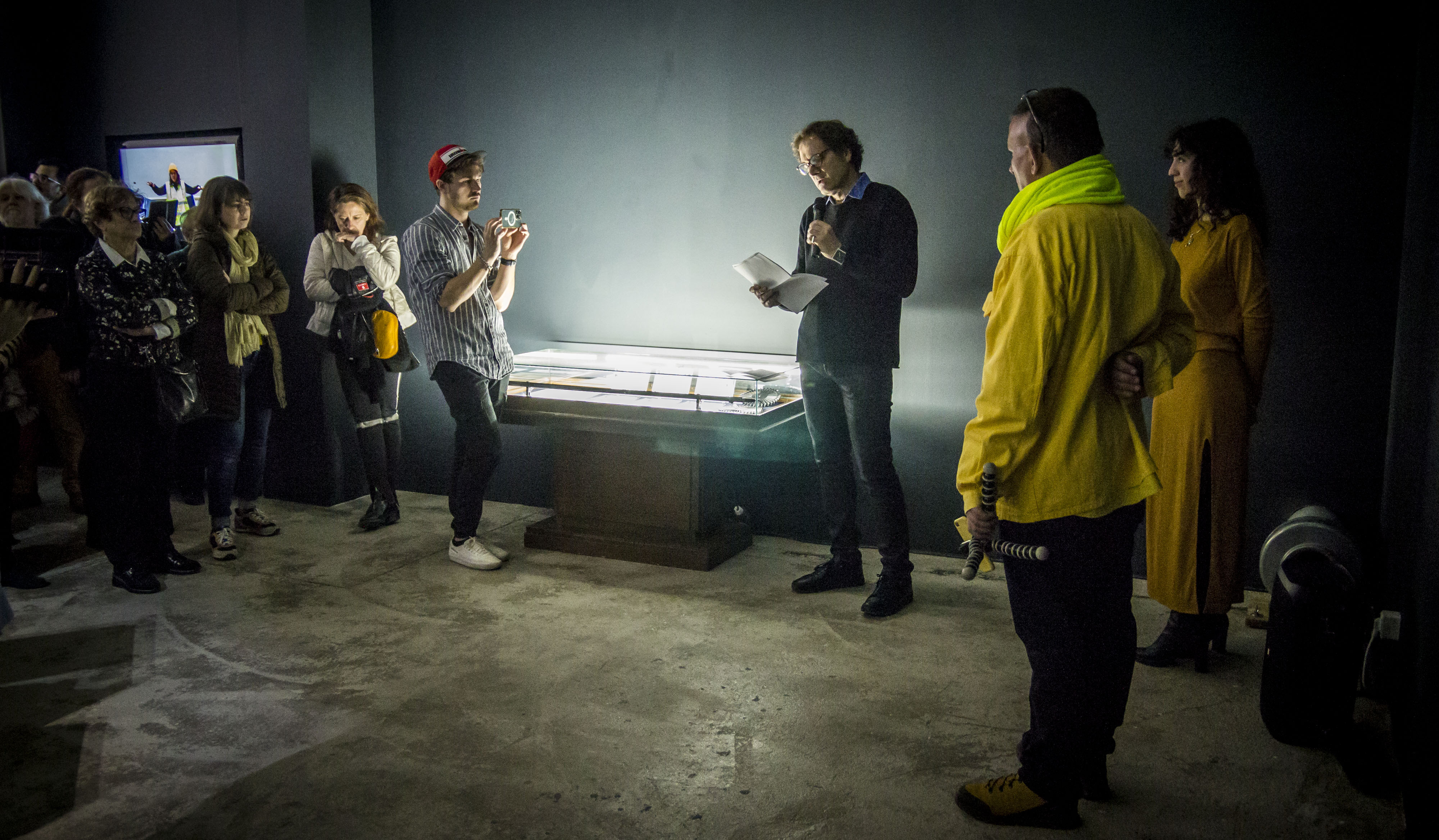
Endre Koronczi, here at the exhibition, presents a work of a manifesto character, I painted the slice In the video titled __, he says that, for him as an artist, the wind is a presence; the wind is the central theme of his creations, the generator and element of his work, as we can experience this in the installations here. Yet, whatever Endre says, let us pose the question – us viewers – as to what this really means. Let us try to look beyond the artist’s abundant information and observe this matter from an external point of view.
I used the word “issue” because, due to the exhibition and Endre’s recent actions, drawings and installations, we might regard wind, for Endre, as more than a symbolic, natural, biological and thus universal element that, in his view, should be discussed. It is an issue because we do not sufficiently recognise its existence, its effect or its meaning.
Wind is the everyday movement of air that, for the average person, results from the equalisation of pressure differences and which fundamentally regulates Earth’s climate. In the city, people hardly notice or care about it unless it becomes strong. Even regular hikers and cyclists find wind to be an unwelcome, uncomfortable prospect that can make leisure activities and time spent outdoors less pleasant.
Sure, let’s not deny it – the wind can have a pleasant side as well. It’s easy to recall moments when its cool or refreshing nature influenced our mood, eased our feelings, or even brought us happiness.
After all, Endrének is right—wind has an impact on us, it can serve as a metaphor, so why not make it a central element of this art? The notion that the weather’s breath and our breathing, the salt spray that moves in and out of the body, could be unified into a single concept is both logical and well founded. How many fairy‑tales do we recall? We could cite a children’s book illustration or a cartoon where wind is a benevolent cloud with a human face, blowing the heroes to the right place, thereby aiding their world‑shifting journey. And why not make breathing and wind a single element, universal and mystical, by uniting the outer and inner airflow—and even the expansion of the universe—into one?
From the start of Endre’s practice, this motif has been part of his art since the mid‑nineties. If I recall correctly, the wind, as an invisible existence, presented for him a challenge that cannot be captured in a still image or a photograph, yet it fundamentally determines the conditions that are photographed. Since then he has produced a great many works on the subject, ranging from floating nylon bags to monumental films rising from the early‑morning heat‑wave, and still this exhibition may be the one where the theme’s versatility and the artistic programme it offers coalesce for the viewer and become intelligible beyond itself.
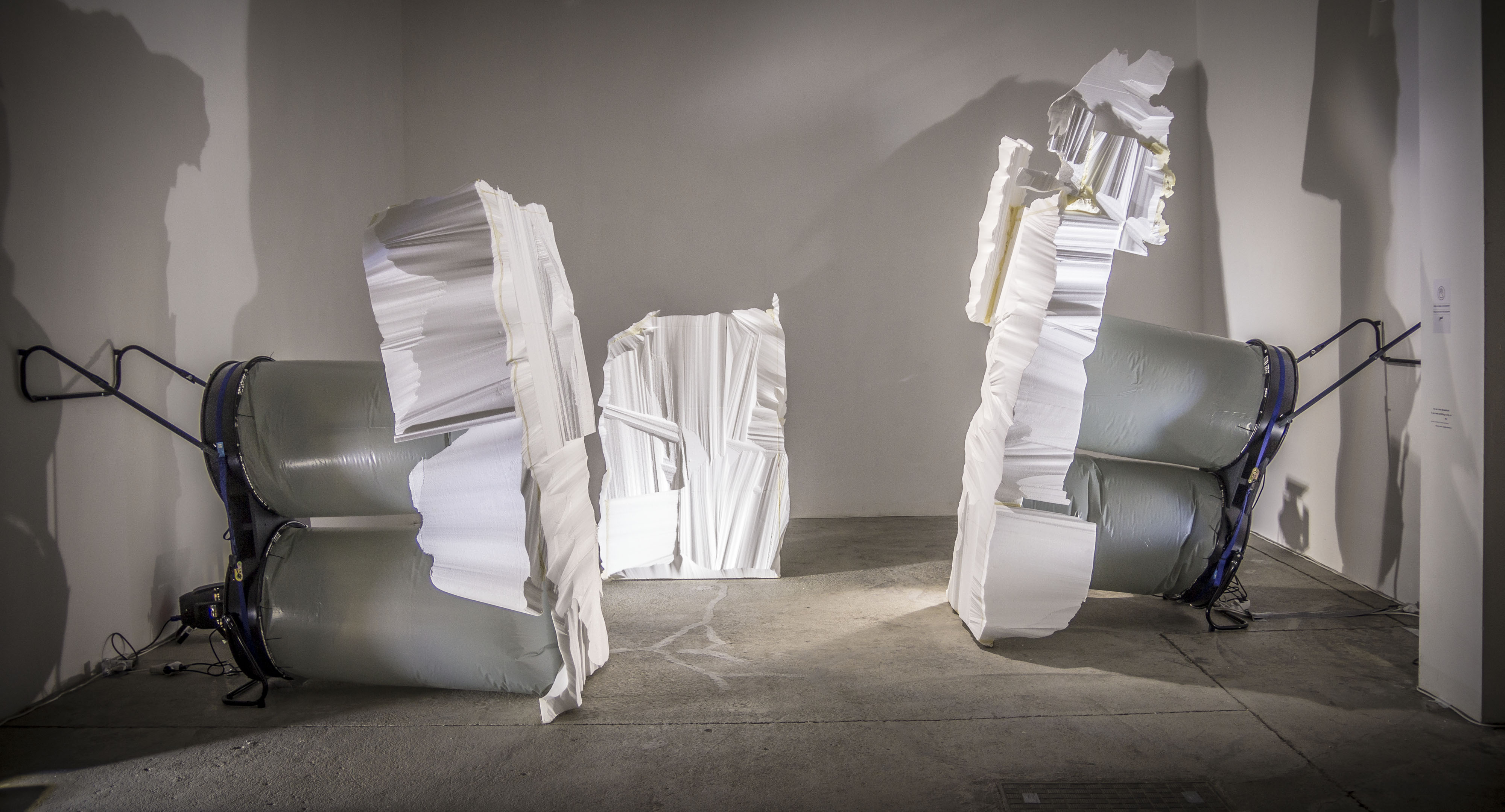
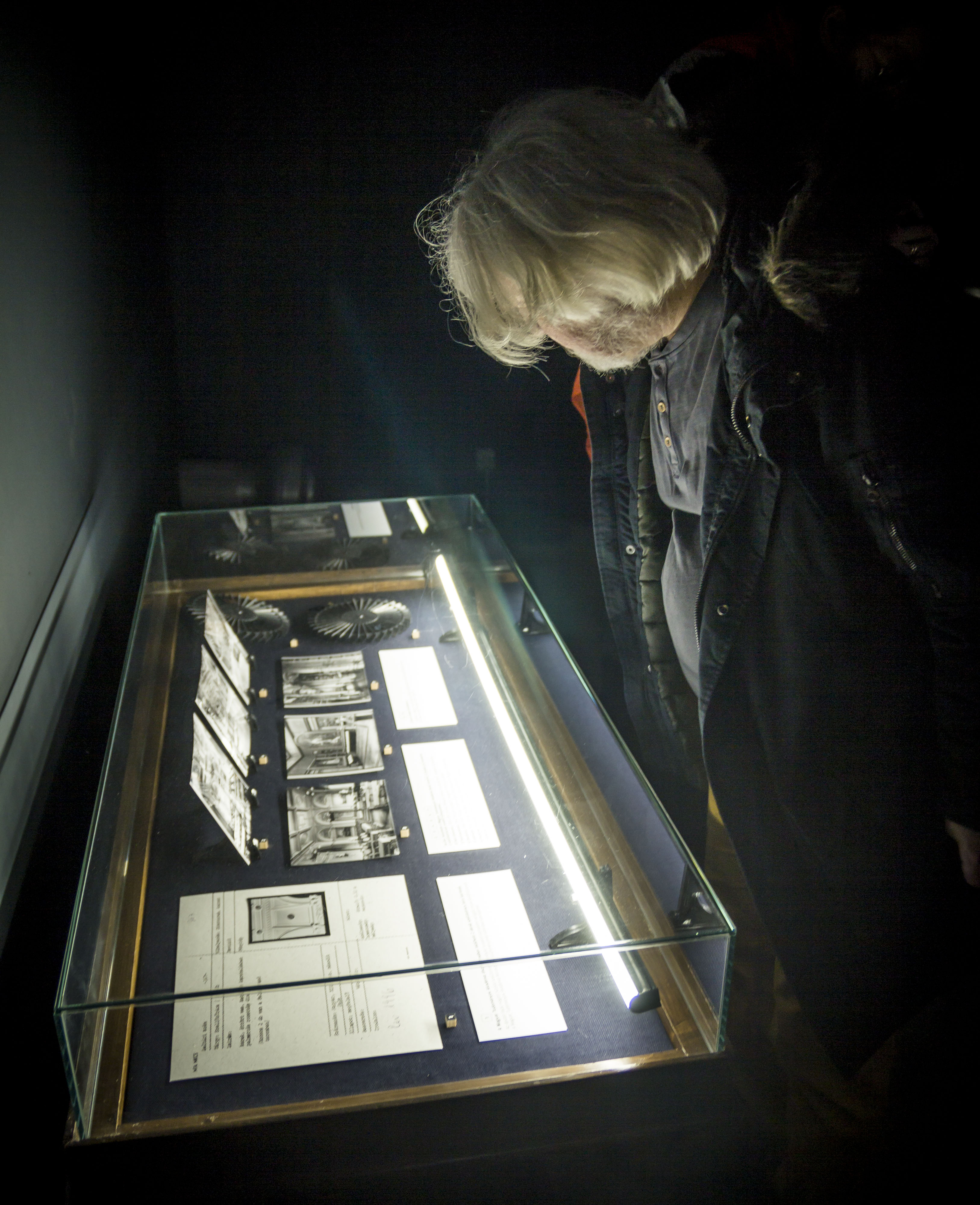
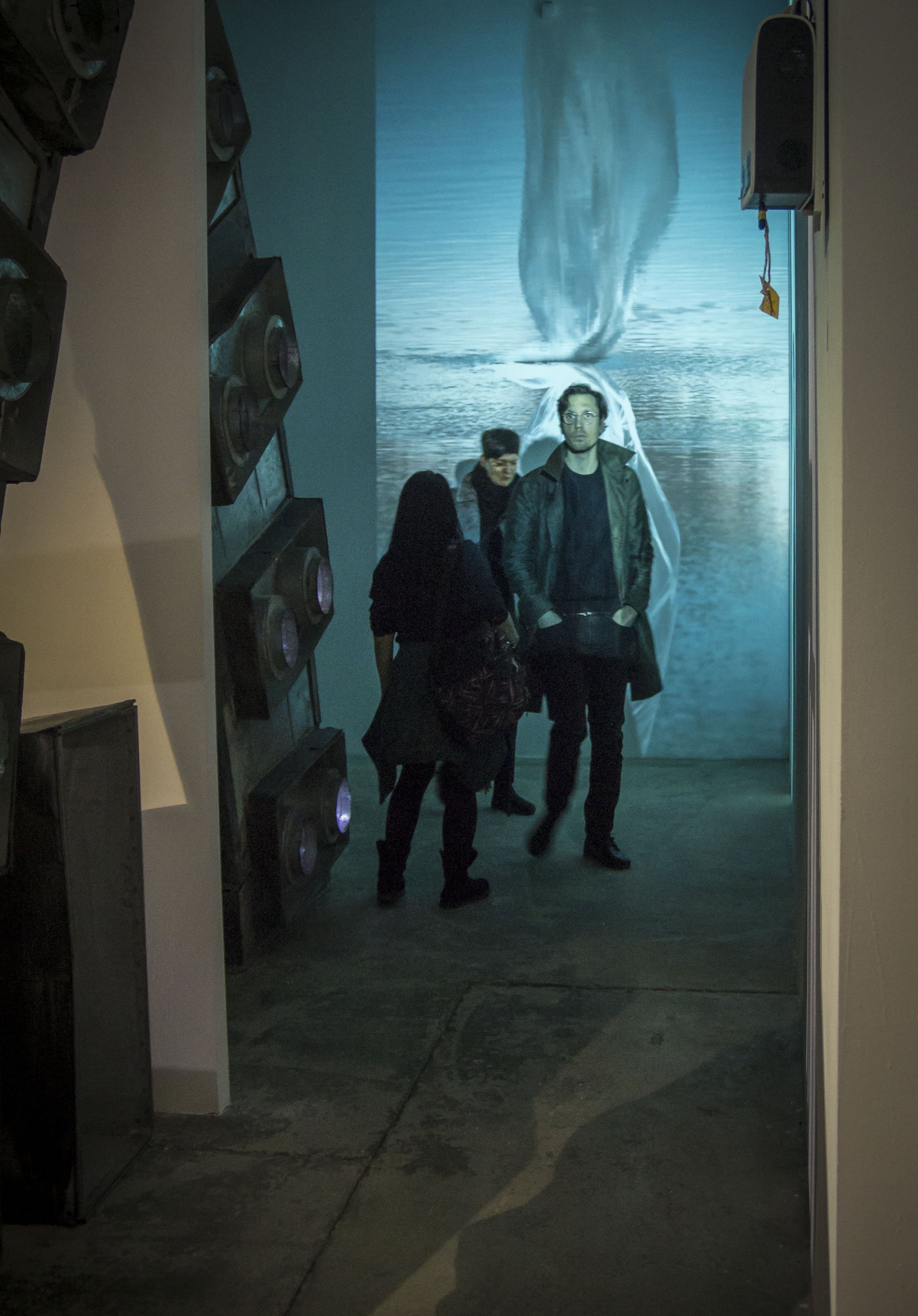
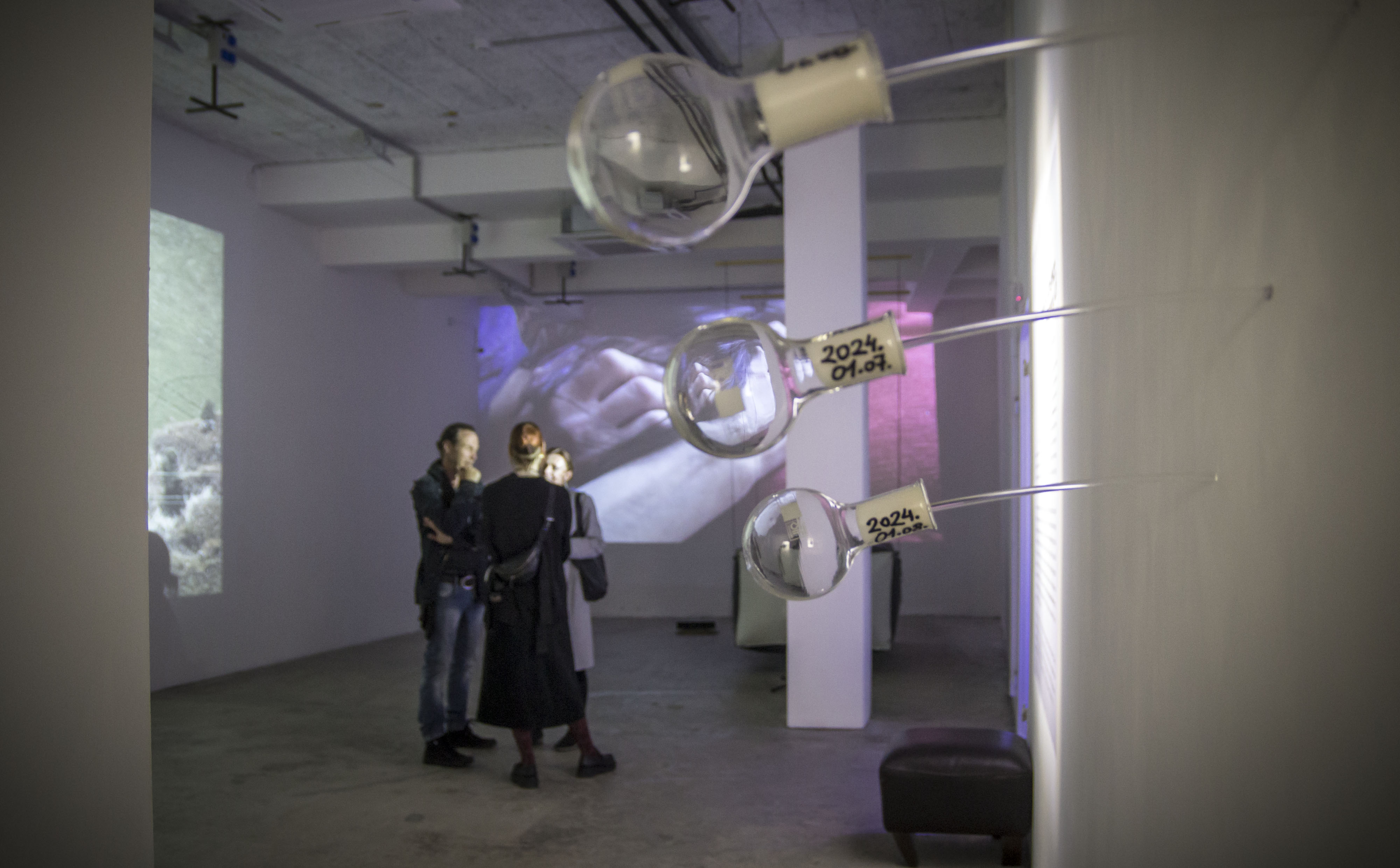
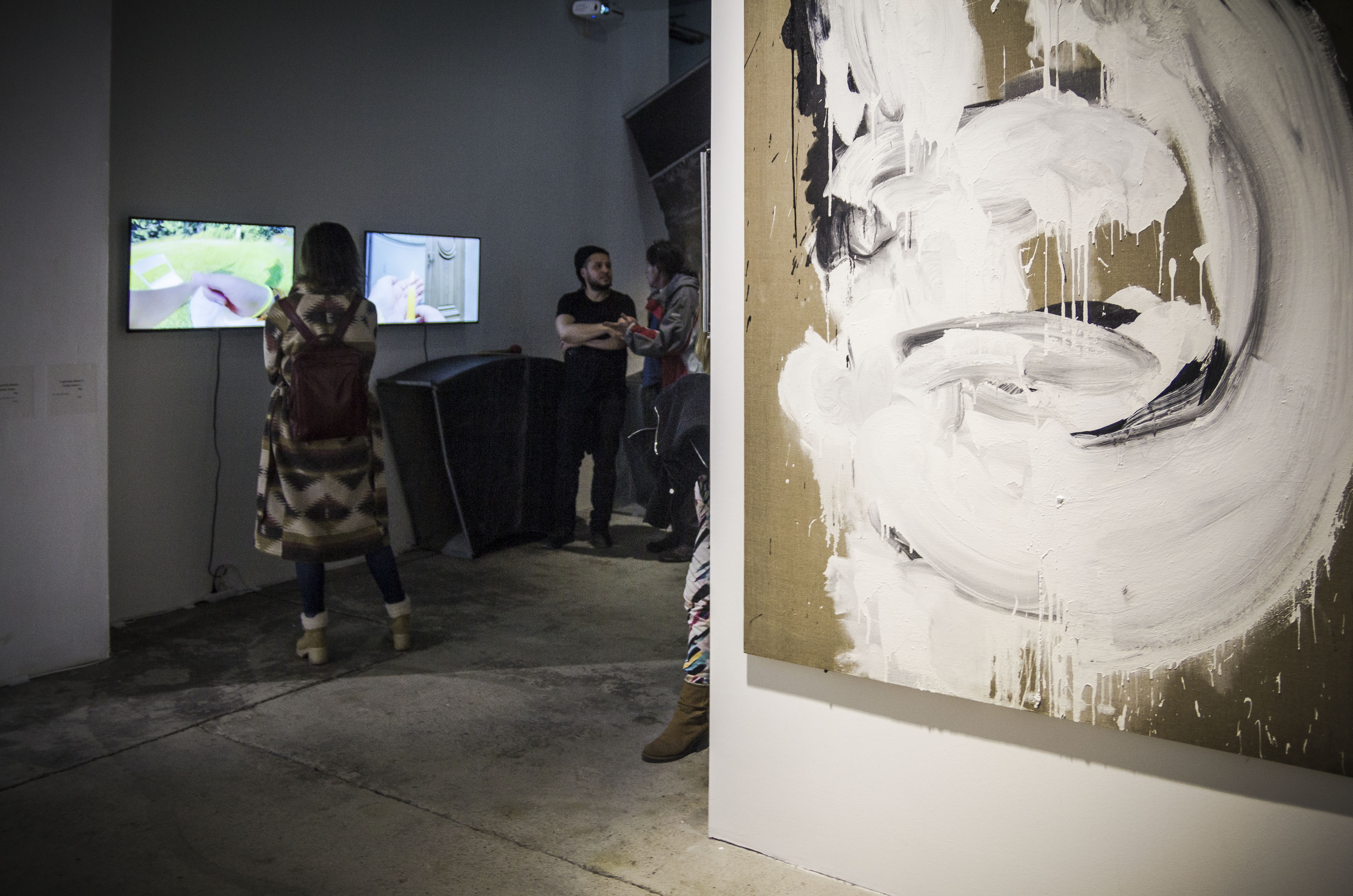
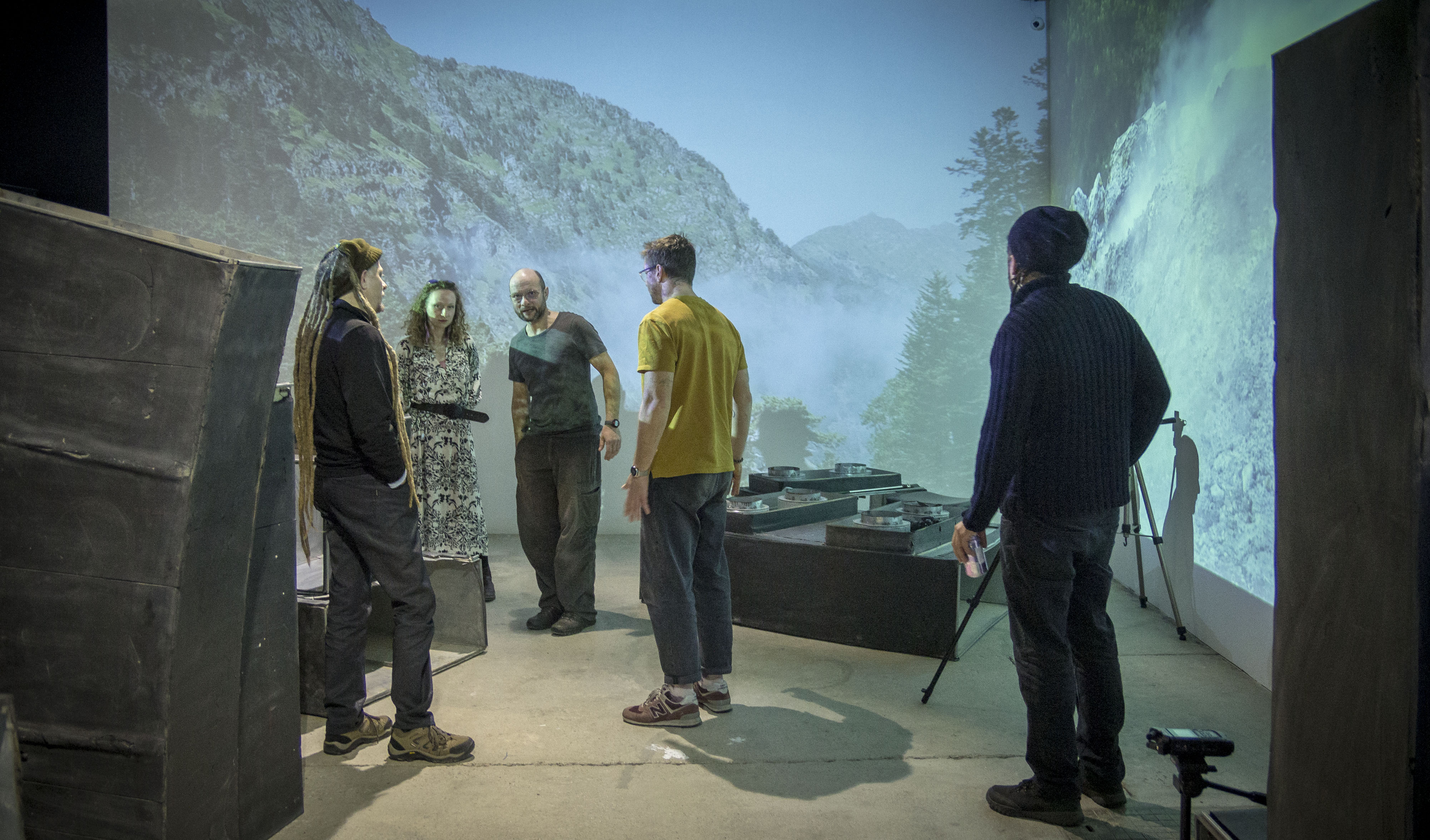
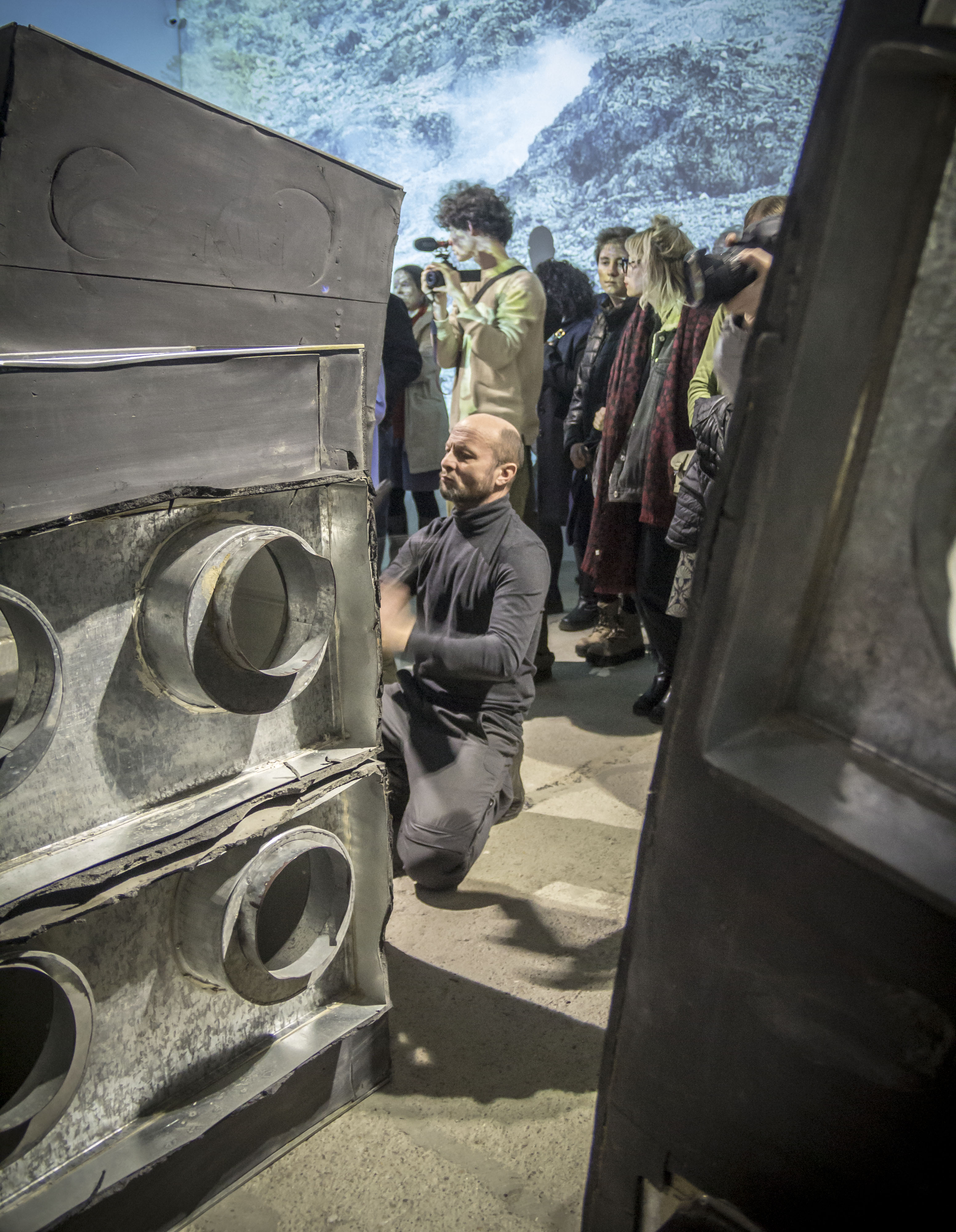
The exhibited works examine every aspect. Here we can see a truly slice‑generating piece, a mobile sculpture propelled by airflow, drawings and paintings that were created by observing the wind, and we also see their windings – collections of other peoples’ breezes or Endre’s own glass‑sealed windings. Another element that enters the discussion is the discovery of building airflow, which pairs an unexpected historical dimension with the movement of air. The Hungarian Academy of Sciences’ ventilated system in Endrében bears witness to the breath and presence of great forebears. The walls preserve the spirit of our ancestors; their breath has permeated the building’s air‑moving paths and ductwork.
The exhibition of Endre Koronczi is a heroic undertaking; today it is rare for an artist to create a work that addresses the senses, a manifesto about art, and that does not concern itself with whether the pieces will find a home in an institution or a collection. This is a highly valued aspect of Endre’s practice: he does not focus on commercial viability but only on artistic considerations. His installations are not made from enduring materials; they are constructions that may, in a future showing, be reborn in a different arrangement.
For Endre, wind is a matter; it has even been renamed a term that received a naming ceremony. But is the wind really a matter? Does all this lead somewhere? Will we gain anything by, in Endre’s spirit, recognising that air movement is not only an external force but also an internal flow? What will happen if we recognise it?
During the installation I asked the artist whether there was anything ironic in this presentation, or whether a trivial element lurks at the heart of such a painstakingly serious analysis. If the theme is both serious and ironic, if the 100‑day self‑infliction drive is not brutally grim, then everything we see also recalls a wider historical context and, as a body of works, can be summarised along art‑historical references. The Fluxus artists of the sixties preached the unity of life and art, that the small signs and activities of our everyday lives can be interpreted differently, as creative acts, and all this is merely a matter of attitude. The boundary‑pushing view of the neo‑avant‑garde mixes poetry, everyday experience and visual art, providing a lifelong blueprint for the next generations. For reference, the wind circulating in Tarkovsky’s films or in American beauty, the candle scene in Nostalgia, or whatever appears in Koronczi’s work seems to carry on their testimony, reinterpreting them by arguing that small gestures are amplified into genuine works because they clearly believe that art has purpose, namely that it can depict something that affects our thinking, our senses and our relationship to life. There is no doubt about this: Endre’s exhibition has an elemental effect, it lifts, because it convinces us that one can ride an emotional roller‑coaster with the works, and draw the lesson that everything in the world has meaning, even wind and breath. Thus art becomes a business.
Finally, let me tell you a story:
The cinke and the wind
The cink perched on a sycamore branch. The wind rattled its feathers. It was shivering.
- “Pull, but you’re very cold,” the wind said to itself – “you could blow it warmer! - “I’ve been blowing quite warmly during summer,” the wind replied. - “Now it’s winter, so I must blow cold.” - “Don’t be indecisive,” the child said. Your problem is that you’re always indecisive, then you grow old before your due date. You move like the blade that lives at the mountain top.”
- How did its tail go? – asked the wind, and it hushed its voice so that it could hear the cinege’s tale more clearly.
It behaves just the way I say. It’s always been a little wobbly, fluttering, and on a fine day the many poisons bit it, the feather fell out, and it grew old. Now it gurgles at the top of the hill. It can’t fly again because it’s lost its wing feather as well.
The pigeon told me that he had seen it. He also lamented the poor. He shouted thrice, how awful the damage was: “Woe, woe, woe!”
- “What a farce,” the wind howled. “Listen, I don’t need any feathers at all if I want to fly!” - “One can also plough through poison,” the wind replied. “Haven’t you heard of the mole’s case?” - “I haven’t. Just tell me,” the wind pleaded. And then it fell completely silent, listening to the snail’s tale. - “The mole lived in the hollow of the thistle‑rose bush,” the snail said. “He mistakenly dug his tunnel beneath the hollow of the bush.”
It took him quite some time to realise that the roots were blocking the way. But that made him so angry he only wanted to live where the rosebush was. He kept struggling until, in his fury, he drove his head between two sets of roots, but could barely pull it back; the roots had clawed onto his neck, and he barely managed to escape.
- I heard the story from the street corner. - Such a sad tale, isn't it? - How dull‑faced a story, indeed – the wind sighed. – It has nothing to do with me. I do not live underground.
- "Hooray!" shouted the film geek – "you also manage to cram into every hole. Whether not under the ground, you just burrow into every branch. I'd like to know what joy you find in such childish hide‑and‑seek?"
You, who are so great that you could step upwards even on the tallest rock, are indeed a giant! Yet you spend your delight on this low oak. I fear that you have already grown old, and your strength no longer carries you to higher expeditions.
Node has already finished the slice, killing the poison.
- I'm sorry for bringing this up, you little idiot. But why did I ever listen to your dull, meaningless stories? I have to climb over the Carpathians; the northern wind awaits me. I might even get lost because of you!
He screeched and fell apart. A silence so profound followed him that even the air seemed to hush.
The little clowny had been waiting for this. He disassembled his crumpled quills and tucked his head under the wing. He was about to sleep, and then the darkness fell over him.
- Without wind I somehow manage to pull this cold winter night through – he whispered cheerfully.
Well, we are also with the wind. It’s interesting if it stinks, but better if it doesn’t. With these words I open the exhibition.
Petrányi Zsolt