Godot Institute’s exhibition of the year 2026: 20,000 visitors saw drMáriás’s anniversary show
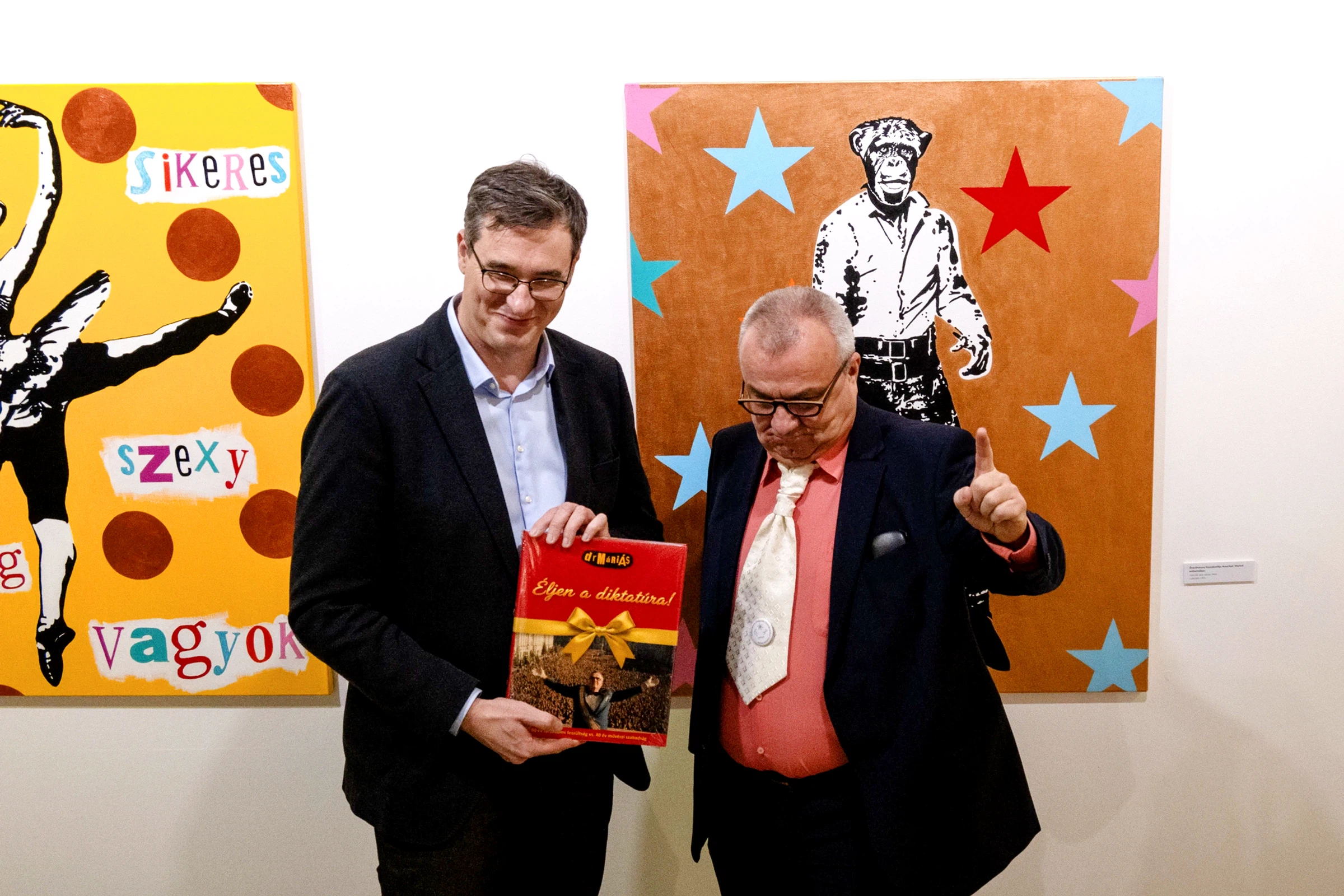
The closed drMáriás “Long live the dictatorship!” jubilee exhibition at the Godot Contemporary Art Institute drew 20 thousand visitors since its February opening, the artist’s personal gallery tours ran full to capacity, and about 1500 copies of the same‑titled album found owners.
It’s no exaggeration to say that this was the Godot year exhibition.
The drMáriás exhibition was not simply a successful show; it became a shared cultural experience that remained a lively topic of conversation for months. Visitors not only saw the works, but returned, debated them, laughed, re‑interpreted them, bought an album, came for guided tours, and often brought others along. A genuine community interest grew around the exhibition.
Az Éljen a diktatúra! drMáriás was one of the most comprehensive showcases of the visual arts, literary, and musical world. Paintings, graphics, texts, documents, and personal stories sketched out that unmistakable universe in which humour, the absurd, historical memory, politics and pop culture coexist simultaneously.
The exhibition’s unique power lay precisely in the fact that many visitors did not experience it simply as an art event. The images functioned simultaneously as mirrors, jokes, political commentaries, historical reminders, and liberating laughter. Many people returned twice: first for the power of the collection itself, then again from a different perspective, seeking new meanings.
The success has also proven what the Godot Institute has stood for for years: contemporary visual art is not a narrow professional matter. If an exhibition raises strong questions, can evoke emotions, and contains humour, pain, recognition and courage, then the audience finds a way to it.
The success of the Dr Máriás exhibition is not without precedent. Over the past years the Godot Institute has carried out several large‑scale projects that have reached a wide audience. These included the Imre Bukta exhibition, the Banksy exhibition, and Endre Koronczi’s *Kérem, sóhajtson, Széchenyi Úr!*, a show of professional significance. Together, these exhibitions demonstrate that over the last six years the Godot has grown into a leading contemporary visual‑arts institution.
This is particularly important because the Godot Institute operates as an independent, contemporary private museum. Without state or municipal support it has produced exhibitions that have proven, in terms of attendance, professional authority and public interest, that there is a demand for contemporary art. The drMáriás exhibition’s 20 thousand visitors is another strong proof of this.
The joy of success is accompanied by responsibility. The Godot Institute continues to search for a new, larger venue, supporters, sponsors and long‑term collaborations, so that it can carry on and expand this work. We believe that the work of such a sizable, audience‑building contemporary art institution is not merely a private matter but an asset to the entirety of Hungarian cultural life.
In the coming period we are preparing for more major projects. The Godot Art Expo will continue, which for years has provided an important showcase and sales opportunity for contemporary creators. At the same time we are working on a large‑scale, museum‑pedagogical exhibition aimed at families and children, which aims to make the connection to contemporary art feel natural even at a very early age.
The drMáriás exhibition has closed, but its story has not ended.
20 thousand visitors, the sold‑out exhibitions, the 1500 sold album and the months‑long public attention all signal that contemporary art is alive, it shocks, sparks debate, and creates community.
And if we ignore it, many more people are interested than most people think.