- Dates
- 18 May 2006
- Venue
- Godot Galéria · A korabeli cím ellenőrzés alatt.
- Press contact
- [email protected]
Short listing
An exhibition revived from the Godot Gallery’s original WordPress archive.
Full exhibition text
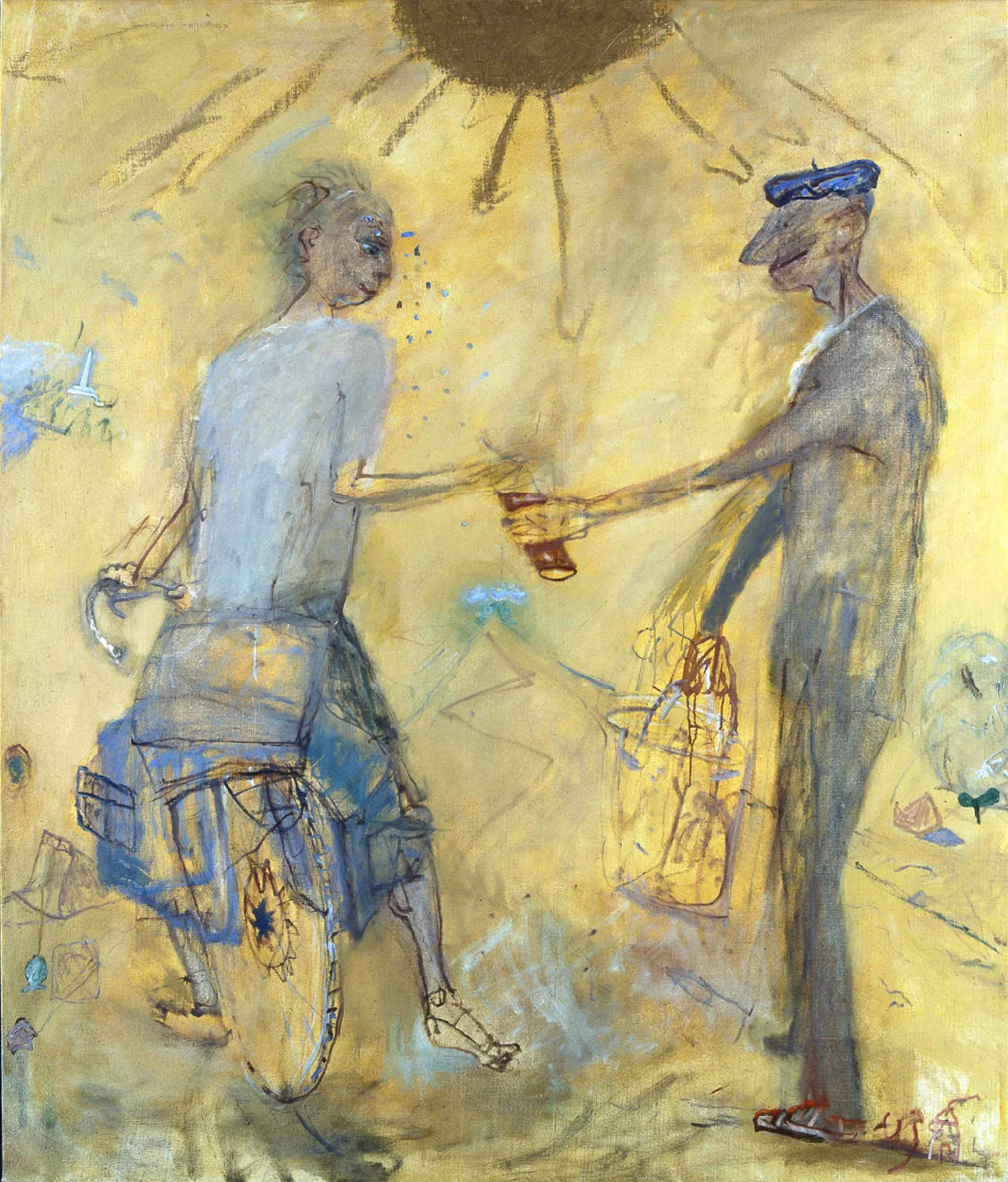
Encounter, 1996
Godot Gallery respectfully invites you and your friends to the opening of Péter Ujházi’s retrospective exhibition 2006 on 18 May at 20. The exhibition will be opened by art historian Nagy T. Katalin.
UP 66
Ujházi Péter, the painter, has a collection exhibition at five galleries in Budapest.
Shaman, 1986
Péter Ujházi's work has already earned him the high standing it deserves; countless accolades and essays have been written about his art in recent decades, and his works are listed in museum inventories. In 2000, a short monograph on his oeuvre was published by art historian Márta Kovalovszky. Over the past forty years he has won numerous exhibition awards, received the Munkácsy Prize in 1987, and in 2004 was named Artist of Honour of the Hungarian Republic. The rich milestones of his life’s work have been regularly presented by the St. Stephen, King of Hungary Museum in Székesfehérvár, most recently in 1994 in its collection exhibition in Székesfehérvár. In Budapest, in recent decades small self-run galleries (Studio 1900 Gallery, Várfok Gallery) have held shows of his latest works every one or two years.
In 2006, the capital is paying off a huge debt, and with the participation of five Budapest galleries, the artist's old and new works will finally be on display.
Great Tower, 1973
Ujházi Péter's life, together with a career spanning more than three decades, is rooted in Székesfehérvár. He was born in that city in 1940 and returned here after completing his painting studies at the University of Fine Arts in 1966. His narrative, irony‑laden canvases record both history and everyday life in parallel. In the mid‑seventies the distinctive, multi‑view maps he composes increasingly draw him toward assemblage, the realm of boxes, and in the eighties he moves on to collage, spatial paper works, and paper dolls, before, in the nineties, turning to sculpture where a grotesque ceramic panopticon emerged. Although fundamentally a narrative artist, Ujházi has always been attracted to landscape painting. The Nadap leaf‑box series is an impressionist landscape diary that began in the late sixties and continues to this day; its constant setting and muse is Nadap, a small village in the Velence Mountains.
Venice Overpass, 1975
Snapshot or ordinary scene, heroism or banality – after the “sebészi” gaze of Ujházi, the real faces of things are revealed, often absurd and pitiful. Ujházi skilfully submerges, distills, observes and tells, as only he can, what only he sees – from Nadapt through New York, from Budapest to Lisbon. Boxes, pyramids, administrative‑graphic prints, triptychs – each is a fragment of the world, like a stage play in which the actors enact something from our lives, and even partially the whole is present. His photographs extend, twist and re‑voice space, placing his figures in a unique system of relations. This individual perception of space suddenly no longer fits in two dimensions, and the artist began building boxes alongside painting. In Ujházi’s body of work certain periods can be distinguished, yet each type of work or single‑installation group remains constantly present with minor omissions. Such are the boxes, or the Nadapi garden cycle.
The works on view in the Bartók 32 Gallery are from the 70s and 80s, and at the Budapest Gallery the public can become acquainted with the artist’s output from the most recent decade. The three smaller self‑curated galleries each showcase a different theme or body of work: the Pintér Sonja Gallery presents pieces inspired by Nadap and New York, the Körmendi Gallery displays the so‑called “earthy” paintings and ceramics, and the Godot Gallery features collages, paperwork and leporellos.
The Budapest exhibition series tries to bring out something from this thematic and stylistic diversity, and from the rich arsenal of an artist who reflects on the likenesses and wonders of the human and natural world.
Örs Commander's Square II, 2001
Bartók 32 Gallery
May 18-June 16 – opening 16h.
Budapest Gallery
May 18 - June 25. Opening 17h
Körmendi Gallery
May 18 – June 9. Opening 18h.
Sonja Pintér Contemporary Gallery
May 18-June 24. Opening 19h
Godot Gallery
May 18–June 3. Opening 20h
Godot Gallery
The exhibition can be viewed until May 16, from Tuesday to Friday 10 and 18, on Saturday between 10 and 13 o’clock.