- Dates
- 4 October 2005 – 29 October 2005
- Venue
- Godot Galéria · 1075 Budapest, Madách út 8.
- Press contact
- [email protected]
Short listing
A revived exhibition from the original WordPress archive of Godot Gallery.
Full exhibition text
Trans‑subjective
Double exhibition of József Szurcsik
Ericsson Gallery
Opening: 2005 October 4. 16.30
Opening: Katalin Nagy, art historian
Open: until 29 October on weekdays from 8 to 17 o’clock.
Address: 1037 Budapest, Laborc u. 1. Phone: 437 7100, Fax: 437 7467
www.ericsson.com/hu
Godot Gallery
Opening: 2005 October 4. 18.00
Opening: Katalin Nagy, art historian
Open until October 29: Tuesday to Friday 10 to 18, Saturday from 10 to 13.
Address: 1075 Budapest, Madách utca 8., Tel. fax: 322 5272
archive.godot.hu
Szurcsik József: Rejtőző
In Budapest, the Godot Gallery, in partnership with the Ericsson Gallery, has organised a dual exhibition to showcase the latest works of Munkácsy‑Award‑winning painter József Szurcsik.
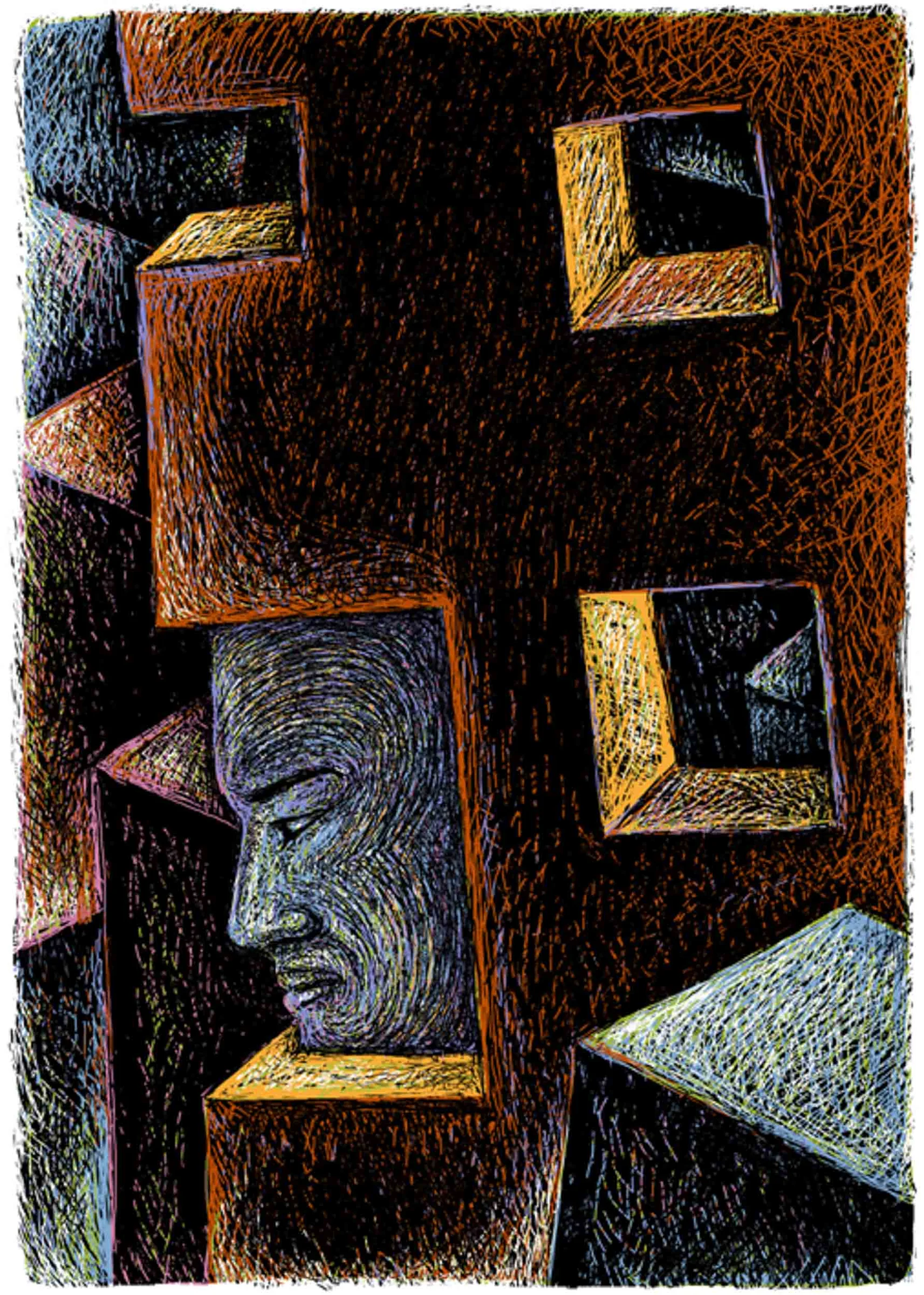
Under the title “Transzszubjektív”, Szurcsik’s paintings and graphics from last year are being shown in two venues. The artist, who works across the traditional branches of visual art – painting and drawing – as well as in multiple graphic processes, exhibits his paintings at the Godot Gallery on Madách Street, while his new graphic series titled “Pokoljárók” can be viewed in the Ericsson building on Laborc Street.
Szurcsik József: Derengő
József Szurcsik has long examined and researched our human relationships and our connection to the environment, conveying his experiences and intuitions through a decisive, powerful visual world and a consistent symbolic system. The current premise concerns isolation and turning inward, evoking the image of a community building bunkers side by side, increasingly atomised; it presents the proliferation of walls of solitude. He portrays his figures and complex spaces with sensitive painterly and graphic solutions, engaging surfaces, and expressive colours.
Szurcsik József: Forgetful
The world we confront is full of tension and upheaval. Is it proper to conclude that “We have become walls, we will become walls,” a conclusion that the art historian Katalin Nagy formulated after seeing the images in the foreword to the catalogue produced for the exhibition?