- Dates
- 31 January 2007 – 24 February 2007
- Venue
- Godot Galéria · A korabeli cím ellenőrzés alatt.
- Press contact
- [email protected]
Short listing
An exhibition retrieved from the original WordPress archive of the Godot Gallery.
Full exhibition text
The Godot Gallery respectfully invites you.
Contemporary Self‑Collections X
for the exhibition titled, on which
György Bélai
From its collection we present a selection.
Opening: 2007 January 31 at 20.
Opening: Jancsó Miklós, film director
Larger size
Gábor Záborszky
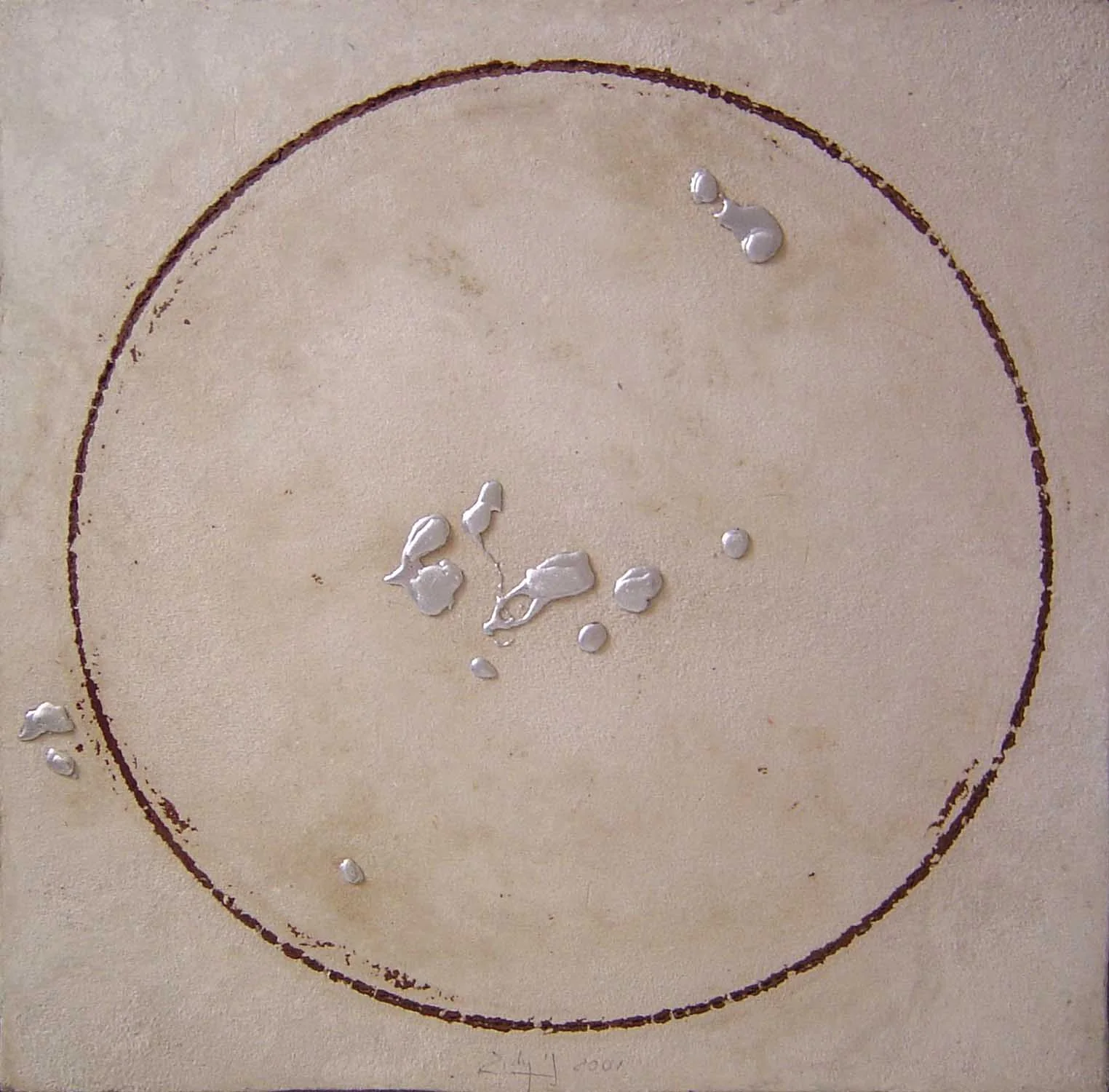
The exhibiting artists: Balogh László, Barabás Márton, Bartl József, Csernus Tibor, El Kazovszkij, Gyarmathy Tihamér, Győri Márton, Haraszty István, Jovián György, Kelemen Károly, Lossonczy Tamás, Marosán Gyula, Orbán Attila, Ottó László, Soós Nóra, Szemadám György, Szikora Tamás, Váli Dezső, Záborszky Gábor
Greater size
Tamás Szikora
An article by Gábor Ébli about György Bélai:
Artchivum. Art‑historical research and art collecting in the spirit of the XXI century
The Artchivum Database is the biggest new development in Hungarian art‑historical research since the transition. Soon the work on the several‑hundred‑square‑metre inner‑city site will also begin, where the new‑approach research can take place. The core idea is to gather every piece of information available on all Hungarian visual arts (fine‑art, industrial, photographic, architectural, folk, even dance) into a unified system and in a computer‑searchable form.
The uploading of the basic data required for this – names, institutions, dates, locations, categories – has taken several years. In the meantime, coupled with development and testing, the first module of the computer system has also been completed; it records those items and makes them searchable across a wide range. Research aspects can be combined from broad searches to precisely specified questions.
The database’s foremost requirement is completeness in every possible sense. Millions of variations of lexical data have been uploaded to the computer. The system places the data into semantic fields using thousands of the programme’s perspectives. In this context, the number of search versions is virtually infinite. Over the years a team has been uploading the data, while today the interpreter—the professional work—is undertaken by eight young art historians.
Currently one hundred and twenty thousand people, with three hundred and seventy‑eight thousand name variations, and thirteen thousand institutions have been processed. The number of documents in the database reaches thirteen thousand. This is a huge figure, for fully processing data‑rich books can take months each. It is increasingly common for researchers who learn of the venture to find traces in this database of information that cannot be found in other prominent national visual‑art databases. Although the research centre is not yet open to the public, it welcomes these enquiries, because each request is a trial of the system still under development. Negotiations for collaboration are already in progress with the Institute of Art History and the Data Repository of other public collections.
Now the database has become the centre of a true book and archive collection over the past few years. It already contains more than a hundred thousand items – the number of tangible, largely Magyar‑centric art documents that have been collected. Among them are many rare catalogues. The material extends from exhibition invitations to books, covering every kind of information carrier. The database’s reputation now spreads so quickly that institutions and private individuals independently contact us to suggest and submit their documents, knowing that they will be processed within a foreseeable time and will then be publicly available. As a recent example, original details from the correspondence of Lajos Kassák have just been added here. Once the collection and processing of past Hungarian art documentation is fundamentally finished, the database maintainer’s task will simply be to work with the current holdings and any information that re‑emerges from the past.
Bigger size
Vale Dezső
The database also extends to the works of art themselves. In the second stage of processing, the effort of high‑performance scanners produces a vast collection of outstanding reproductions. Viewing these online not only speeds up research by an order of magnitude and allows multi‑faceted searching, but it will also be a model of conservation, as the traditional book and data archives only barely issue the brittle paper leaves of a catalog from a century ago. Yet the database is not merely a collection of objects; it is a body of material that envelops the widest possible social context of art, not just its aesthetic one. The intention is not only to create the most complete research base, but also to present art within a new system of relations. The believed aim of the database, beyond accelerating the existing traditional research, is methodological innovation and training for the next generation of art historians.
It presupposes the third keystone of the enterprise – the public. The database’s construction has so far relied entirely on private financial resources, yet its future operation will be public. This also heralds the domestic rooting of the American‑style philanthropy: to create a public‑benefit intellectual value with a private initiative and financial backing. The public will not be confined to the profession of art history, but will be addressed to any interested party. The search criteria will be comprehensible to the wider audience rather than specialised jargon. In the physical centre of the database a computer terminal will make the sought information accessible to anyone, and those who hold a research licence will also have access to the original documents themselves.
The centre will operate in a visitor‑friendly manner: it will provide space for artistic events, a book shop, a café and exhibitions as well. A long‑term funding plan has not yet been decided. From the outset of its public operation it will have to be self‑sustaining – precisely so that its continued existence does not depend on the fate, good or ill‑luck, or financial means of a single individual. Charging for information will already be necessary in order to be able to differentiate between those interested in the data for public‑professional, private commercial or purely amateur reasons. The technique for this, however, remains a future mystery.
Larger size
György Szemadám
The Artchívum was founded by György Bélai. Twenty‑six years old, at the age of thirty, he moved to the United States. Because his father was a musician, he grew up in a cultural environment here at home, and he himself travelled the world as a musician, twenty years old. At the end of the seventies he settled in America, where, after putting his instruments down, he found himself among university faculty. He studied economics, law, systems organisation and programming. Later, from his own office, computer systems were sent to large American clients. Before returning home he worked as an economic consultant and then as a vice‑president at a commercial giant.
His interest in the visual arts dates back to his youth, and he began serious art collecting in America. He bought twentieth‑century American and French works. When he settled in Hungary again with his family after the political transition, he also started looking for artists in Hungarian painting who could be matched to modern and contemporary international currents. While getting familiar with the revitalised art market, he increasingly needed comprehensive, all‑encompassing art data. The recognition of real quality‑to‑price ratios, after all, requires extensive comparison: the more works one knows of a given painter, the more precisely one can see or place the artist‑historical analyses, or the international parallels, in their proper context. Such systematic research, which demands that every datum be known and readily accessible, was lacking in the domestic environment – that is, in publications and databases. It still happens that, in the absence of knowledge, professional research runs in parallel, and that market players make hasty decisions at auctions without knowing the appropriate criteria or data, leading to mistakes. These personal experiences in Béi have sharpened his awareness, his artistic interest, his programming routine and the financial possibilities arising from his American career, so that he believes that the best way to utilise all of them together would be to build such a database.
The years spent building the system proved useful in sharpening the eye of its self‑collector. Its taste, aligned with international currents, remained, but its choices grew more precise. Its courage also firmed up, to choose differently from the entrenched domestic standards. The collection stretches from Nagybánya to contemporary artists of today. A superb Rippl‑Rónai selection provides the launchpad. Alongside the master’s pastel portraits, French landscapes and striking drawings there is a strikingly monochrome winter landscape, whose pantheism invites dialogue with a László Mednyánszky painting that hangs in the other corner of the house, suspended in the pale dawn. A taste of other movements of the age is offered by the Art Nouveau work of Géza Faragó, a first‑class plant motif framed and stylishly hung over a Wiener Werkstätte sofa.
The works of Vilmos Perlrott-Czárma from early Hungarian modernism are the closest to those of György Belá. The artist – especially from the period that could be called fauve – has many masterpieces here, ranging from the well‑known Cézanne‑inspired still lifes to an agate girl in the nude, and from the large colour washes that give rise to landscapes. A large painting by Ziffer Sándor is also listed. Among the outstanding pieces are early works by Béla Czóbel and Dezső Czigány; on these the pastel palette creates a lyrical mood. From Czóbel one can see an independent collection, from the portrait of his Parisian art dealer, Monsieur Paquerot, to late, greasy‑applied, black‑contoured interiors. In the urban retreat section are two superb sketches by Lajos Tihanyi, a balanced composition by Ödön Márffy, and one of the strongest works of this part of the collection, a Paris painting by Robert Berény. In addition to the part that reconstructs the developmental line of MIÉNK and the young ones, the individual motif‑rich, internally interpretative life‑works of the era (such as those of Lajos Gulácsy) were not forgotten.
A closed, martyr‑like work that defies international conversion, yet reaches the same level of quality in its artistic output, is another example of Béla Bélai's favourite, István Nagy. From the interwar period, the works of Béla Kádár, Hugó Scheiber and Armand Schönberger are represented with just one single piece each, in a calm humility. From the Neoclassical direction, another quality piece is Gábor Jenő's nude, with a more exciting floral reverie by Vilmos Aba‑Novák in the portraits of Karol Patkó and István Szőnyi, which softly harmonise figure and landscape. A captured moment by Aurél Bernáth is a contemplative female portrait that Béla took in Hungary and then carried overseas to his foreign years. Ödön Vászkó's turning face contrasts with the light, French‑scented colours that János Vaszary uses in blooming flower compositions. A selection of works from several periods of Alfréd Réth's oeuvre offers a return connection to early, the Constructivist‑oriented avant‑garde.
Bigger size
József Bartl
The collection’s further focal points are the European School and some of its antecedents and later traditions. Alongside Korniss Dezső’s marble‑like works, Bálint Endre’s and Ország Lili’s surrealistic compositions, a more concise and tense piece from Gyarmathy Tihamér stands out against his later, slightly more fashion‑like cosmos series, and similarly, Lossonczy Tamás’s canvases are denser compared to his works from the last decade. A central figure in this part is Vajda Lajos: the half‑portrait pair painted by his wife, Vajda Júlia, about the two of them is the piece that comes closest spiritually to the collector. In addition to the quality of the chosen works by Ámos Imre, the power of Anna Margit’s compositions is not left out.
The collection of Gyula Marosán deserves its own praise, complemented by several works of Magda Zemplényi. During Marosán’s emigration to Toronto, Bélá was talking with him, and they decided to organise a nationwide study‑exhibition. The painter’s works were shipped to Bélá, who has now, following Marosán’s death, returned the entire estate home. According to the artist’s notes, even the pictures that went to Canadian buyers are being sought after. A life‑work catalogue is in the works; a smaller exhibition will be open at the Aulich Gallery until the end of summer.
Special, a choice independent of the established domestic verdict, Bortnyik Sándor’s two large paintings from the sixties. In Cohen György’s sobering compositions, we can now discover the bite originating from the very banality with a forgiving smile. Interesting are the works from the fifties by Victor Vasarely and Kassák’s later graphics. Both aesthetically and in documentary value, a few portraits by Szántó Piroska, of herself and of Vass István – the latter, among other things, in a clown camouflage, which, considering the poet’s life, full of contradictions, is more than thought‑provoking – are a positive surprise. Barcsay Jenő’s paintings • also signal Béla’s Saint‑Etrén attachment, and many works by Balogh László. The selection from Bartl József’s oeuvre is indeed vast.
Among contemporaries, Váli Dezső has long since become almost a classic, with no fewer than forty bright‑toned oil paintings in the collection. In the light of Váli’s vigorous, pile‑like brushwork it is not surprising that the collection contains an even larger number of works by László Ottó. Alongside the works of Gábor Záborszky, El Kazovszkij, István Haraszty, Tamás Hencze, Tamás Trombitás and András Wahorn, a diverse range of small lithographs is also available (for example, a piece by Róbert Csíkszentmihályi). Tamás Szikora’s boxed, shadow‑casting pieces also question the relationship between space and flatness, while Attila Orbán’s strong colours and dynamic gestures call up a primordial instinctive world instead of philosophical reflection. The works of Péter Paizs represent a possible path for the modern renewal of geometric tradition, while the young artists Márton Győri or Nóra Soós balance with harsh colours. Some works (such as László Fehér’s staircase motif) are hung to suit interior design. Strong is also the individual and repeated graphical material handled independently, from László Péri to Miklós Borsos. The newest unit of the collection is the photo, which names no fewer than the earliest acquisitions, such as Henri Matisse – Lucien Hervé 1949 photograph.
The exhibition can be viewed until February 24, from Tuesday to Friday 10 to 18, on Saturday between 10 and 13.