- Dates
- 15 September 2004 – 9 October 2004
- Venue
- Godot Galéria · A korabeli cím ellenőrzés alatt.
- Press contact
- [email protected]
Short listing
A revived exhibition from the Godot Gallery’s original WordPress archive.
Full exhibition text
The Godot Gallery cordially invites you to the
Contemporary Private Collections
for the fourth part of the exhibition series,
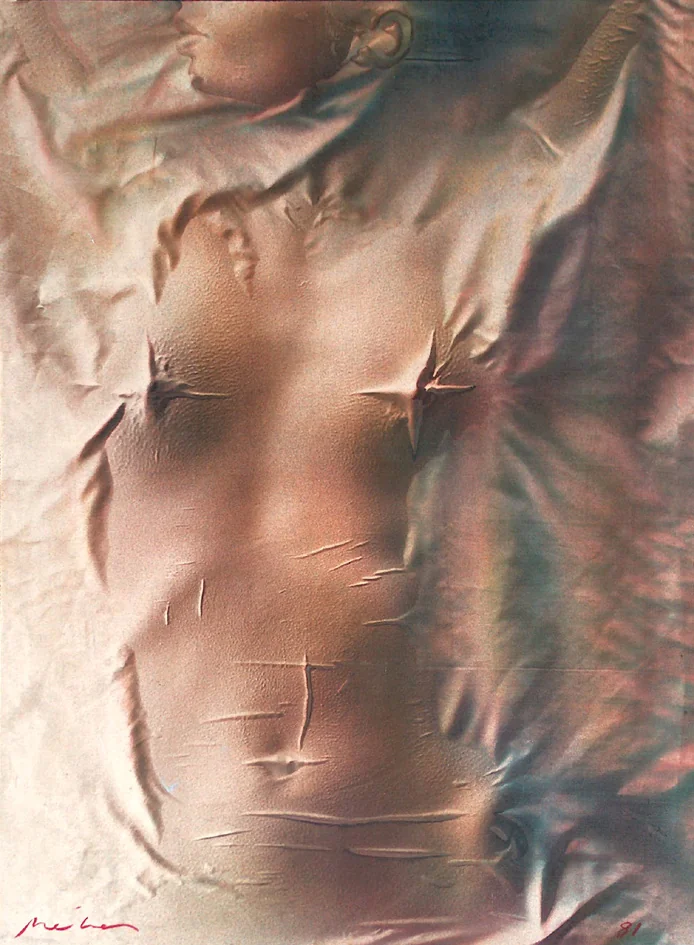
László Méhes
for the introductory exhibition of András Feuer's collection
Opening: 2004 September 15 at 20 o'clock. The exhibition will be opened by Gábor Ébli, artist.
Kinga Hajdú
Artists appearing in the exhibition: Almássy Aladár, Bada Dada, Bak Imre, Bukta Imre, Deim Pál, El Kazovszkij, Farkas Ádám, Frey Krisztián, Gaál József, Gedő Ilka, Gyarmathy Tihamér, Hajdú Kinga, Haraszty István, Kocsis Tibor, Kopasz Tamás, Korniss Dezső, Lakner László, Lossonczy Tamás, Marosán Gyula, Mata Attila, Méhes László, Swierkiewicz Róbert, Szarka Péter, Szűcs Attila, Torma Andrea, Zsakó István, Zsemlye Ildikó.
József Gaál
The challenge of collecting art is reconciling museum‑level quality with an individual taste that breaks the mould of the artistic canon. No matter how high‑quality the works in a collection may be, if there is no unifying personal thread among them, it is not a collection but a mere set of objects. When a private collection adheres too strictly to the profession’s inevitable, reductive, categorising, schooling way of thinking, it loses its individual intellectual edge. Personal creativity typically manifests on two levels. In contrast to strictly chronological, professional classification, one can confidently pair classic, modern and contemporary material; and instead of adhering to stylistic labels, one can prioritise each work’s unique qualities. One must organise the inherent chaos of art, yet do so in a way that preserves its naturalness. The Feuer Collection attempts this.
Attila Szűcs
The classic modern part of the collection embraces the paintings of Pál Szinyei Merse, József Rippl‑Rónai, Vilmos Perlrott‑Csaba, János Kmetty, Ödön Márffy, Dezső Czigány, János Vaszary, Lajos Tihanyi, János Schadl, Gyula Hincz, Béla Kádár, Hugó Scheiber, László Mednyánszky, István Nagy, Géza Vörös, István Farkas, Frank Frigyes, István Dési Huber, István Szőnyi and József Egry, and the sculptural material bears comparable importance: Mark Vedres, Ö. Fülöp Beck, György Goldmann, Ferenc Medgyessy, Elza Kalmár Kövesházi, Géza Gorka, Pál Bor and Imre Huszár.
Kopasz Tamás
Which contemporary art currents might one turn to with such a strong twentieth‑century long‑cut? The transition is offered by the works of Lajos Vajda and Imre Ámos, followed by the artists of the European School (Endre Bálint, Dezső Korniss, Gyula Marosán, Tihamér Gyarmathy, Tamás Lossonczy, Jenő Barcsay and Piroska Szántó). Thus we arrive at the 60‑s and 70‑s, represented by the works of László Lakner, Krisztián Frey, László Méhes and Tibor Kocsis. This faithfully indicates that historical references, formal experiments, and the pop‑art mass‑cultural harvesting all touch the collector. The presence of the Iparterv works – here Ilona Keserü’s scratch‑relief, amid many paintings by István Nádler – also shows that activist messages are truly not far from the collector; at best only major works could have been secured from the neo‑constructivist generation. The loyalty to the kassáki heritage is further emphasised by the fact that, for Feuer, Imre Bak is the foremost living classic. He most highly values his ability to regenerate, even the conscious, disciplined nature of his work.
Imre Bukta
From a very different direction than the obvious, similar depths are present in the collection. Swierkiewicz Róbert’s powerful gestures appear in the most unexpected compositions. The entry of the Souls, for example, is a combination of stains dropped on a wedding‑draped textile and the accompanying small, anthropomorphic bronze figures that have been bolstered there. Other, small paintings shaped tension. A whole series was born from his Indian experiences. Many of the works in the collection illustrate almost every side, signalling that Feuer does not attach himself strictly to a singular oeuvre; he highly values the multi‑directional renewing ability.
Another third creator is represented by this material to the same depth. Imre Bukta, in a certain sense, simultaneously embodies what Feuerbach enjoys in Imre and what Swierkiewicz enjoys in Robert. A consistent line of thought underlies Bukta's works, and at the same time his choice of materials and formal ideas are very inventive. His barely concealed social critique, conceptual bent, and the physical sensibility and material character of his works are all exciting for the collector. A favourite piece rightly is the plastic machine that produces pure wheat from plastic, which showcases every resource in Bukta's creations, and even a separate apparatus built at the collector's request, which, because of its clever design, can be considered a stand‑alone work.
Several of these aspects are also valid for Gaál József, from whom several different works also found their way into the collection. The graphics born from the observation of the Parisian night were arranged by Feuer in the form of iconographic tableaux on the wall. In the profane, one can thus notice the reference to the majestic – a sign for a sensitive eye. Gaál’s other, well‑known, distorted human figures do not merely appear on canvases; they also surfaced in grotesque heads that began to appear in the close vicinity about a decade ago, and have continued to be produced in several series since. For the collection, these latter works are significant. Not only because Feuer bought a whole series at the time of the Dorottya Gallery exhibition, but also because he captured the genesis of the heads. Gaál, after all, only built these heads from the family portrait, from discarded materials such as those from the stable – thereby recontextualising past objects to create new art objects. Simultaneously, this turned him into a sculptor in addition to his graphic and painting work. This again sheds light on the collector’s openness to support artistic processes with his purchases, processes that are unusual in both material use and concept, and that represent a leap from one artistic status to another.
Frey Krisztián
A striking feature of the collection is its atypical adaptation, evident in the objects of Tamás Kopasz’s metamorphosis that have entered the collection. The artist’s works range from a portrait, then a portrait made of iron, a sculpture that can be affixed to a wall, and finally a palaeontological‑style, foot‑bearing sculpture. Feuer takes pleasure in the developmental stages themselves, and his bias towards the plastic medium was already evident in the classic modern material. Today only a few still regard Zoltán Ádám as a plastic artist, so the collector rightfully boasts an early wooden‑textile piece. From István Haraszty nothing is surprising – the legacy of brass plates (**1994**) – but much more so a painting‑application that reminds one of miniature boats. From János Sugár hardly one can find further flat‑reliefs that lament tin, Hungarian oak and bronze. Balázs Fekete crafted lead‑sail boats that, pinned to the painted plywood depicting sea waves, illustrate this. The works of István Zsakó are accompanied by a tapestry of his wife, textile artist Andrea Torma, a tapestry – which she defines not as an industrial craft but as a painting made with gouache – in which Zsakó’s motifs appear. Between genres another example stands, El Kazovszkij’s relief **Jó Pásztor**, whose coal‑knotted figures evoke the stage of performances. From the pioneer of digital processes now known as Péter Szarka several unique materials hide in the collection, and it is no coincidence that the most complex piece, again, relies on material usage and hangs on the wall. From skin, through watermark paper, up to the paint layer, every miracle‑laden work may be considered an abstract, spiritual landscape into which we can enter through the three cuts. If all this is not enough evidence to satisfy Feuer’s demand for an atypical, not self‑consciously but randomly shocking art, then at home we stumble upon several statues of Aladár Almássy. If, for instance, one can at least call it “The Hairdresser’s Dream”, whose dancing figure emerges from the marriage of a hair‑trimmer and a hair‑curler, it sits beneath a hair‑drying vent.
Ilka Gedő
Viewable: 2004. Until October 9.