- Dates
- 3 September 2015 – 7 October 2015
- Venue
- Godot Galéria · 1114 Bp., Bartók Béla út 11-13.
- Press contact
- [email protected]
Short listing
An exhibition taken from the original archive of the Godot Gallery.
Full exhibition text
In a larger size
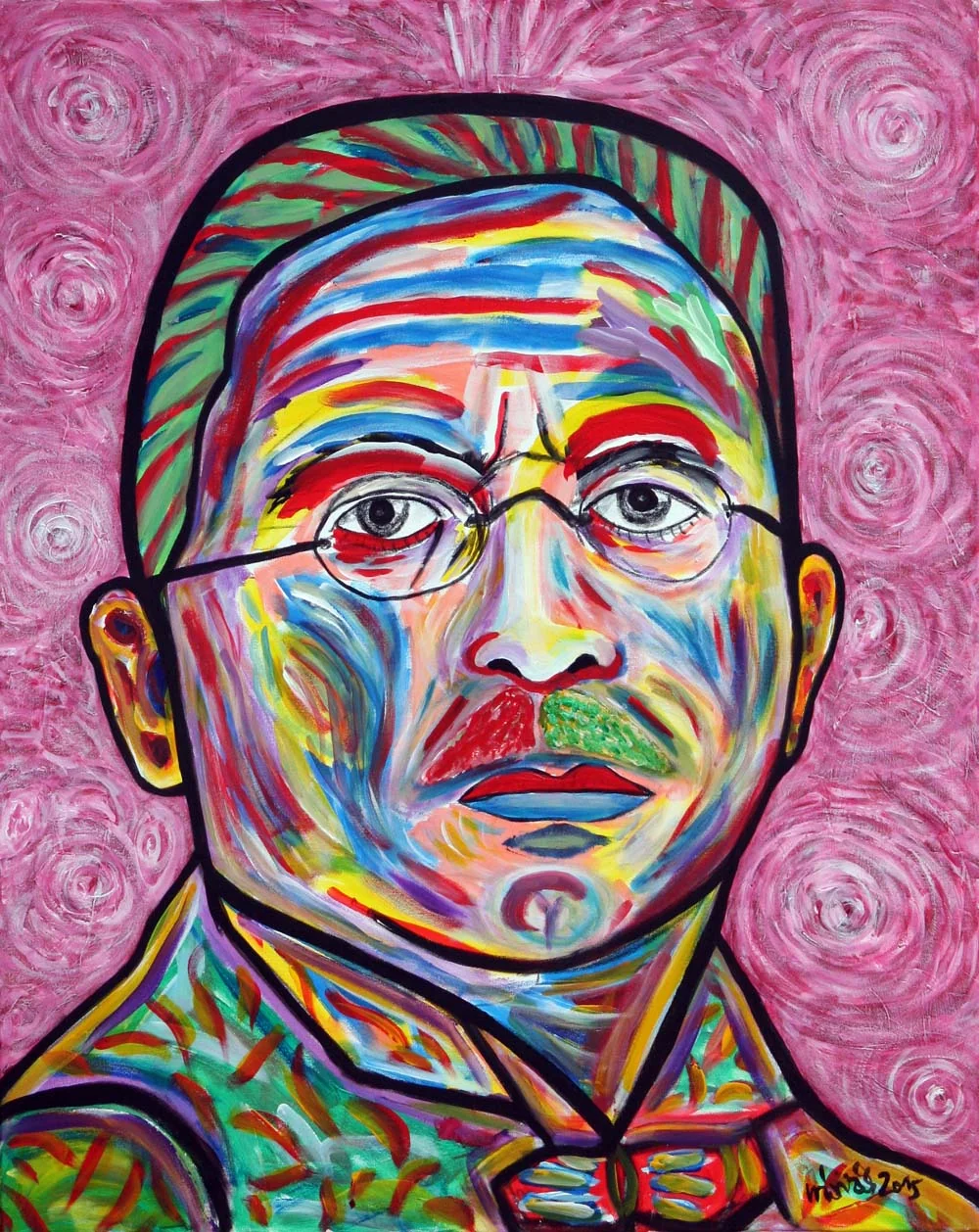
Breivik as a national image
100 x 80, acrylic, canvas, 2015
Hell on the wall!
drMáriás's double exhibition
Ericsson Gallery
Opening: on September 3 at 16
Opening: Gábor Tóth, multidisciplinary artist
Open until October 15 from Monday to Friday between 8 and 17.
Address: 1097 Bp., Könyves Kálmán krt. 11/b
Godot Gallery
Opening: on 3-th September at 20 o'clock
Opening: Fábry Sándor, humourist, art collector
Viewable: from Tuesday to Friday until October 7 from 9 to 14, on Saturday between 10 and 13 o’clock.
Title: 1114 Bp., Bartók Béla út 11-13
Larger size
in the studio of Ignác Trebischt Vlaminck
100 x 80, acrylic, canvas, 2015
At the exhibition, Dr Máriás’s latest paintings and miniature paper works will be on display. A catalogue will be made from the exhibition material, and a limited number will be available for free on site.
In larger sizes
Cannibalism education at the Issei Sagawa University
29 x 21, mixed media, paper, 2015
Do not put the devil on the wall, for he will appear, the proverb says. Yet it seems that people do not believe him, because they enjoy putting the devil on the wall. War, genocide, economic collapse, disease, terror, impoverishment and thousands more atrocities are frequently envisioned with the aim of influencing others' opinions to their own liking. Politicians, journalists, economic analysts, preachers, psychiatrists, writers, dramatists, law‑enforcers, lawyers, teachers and others paint him, because they like it and because they are paid for it.
The problem is that the devil eventually shows itself. When we least expect it, when we would wait, imagine that it might not even exist, then once it does appear and we desperately call for help and want to speak about it, no one believes at all, because by then so many devils have been painted on the walls that they are so terrible, colourful, varied, and frightening that we cannot even recognise them in the body, especially because oftentimes they are exactly the kind we would never have expected: simple, beautiful, intelligent, kind, well‑mannered.
drMáriás is, on this occasion, exploring the theme of evil. Whether or not we can recognise the face of evil, perhaps. First of all, does it have a face at all. For there is one that has written about it, because society has stamped it that way, and there is another who, despite all his horrific crimes, is celebrated as a great hero. Some are punished, and even after their services are finished they are despised, and then there are victors who escape from punishment, and become figures of whimsical images, lounging in happiness, comfort and wondrous well‑being.
In a larger size
In Matisse's studio in Toplancs Giza.
29 × 21, mixed media, paper, 2015
drMáriás chose the subjects for his new portraits from the simplest suspects, through thieves, embezzlers and the nobleised brown‑coats who have become heroes, to the most serious serial killers, terrorists and abusers, placing them in the studios of a renowned artist in the manner he is accustomed to, so that the beauty of art collides with the horrors of reality 1. The way the characters appear – referring to the linguistic style or life situation of a particular artist’s output – is decided within a counter‑point and parallel placement game, which is exciting in its own right because the worlds of art and crime are not always far apart. Indeed, art often crosses the boundaries of innocent beauty into madness, aggression, deception, manipulation and psychological ruin, while even the most monstrous criminals sometimes have good taste, an engaging and insightful opinion of art, and even a valuable and high‑quality collection of works.
Step into drMáriás’ studio and set off on a journey in which art playfully delivers truth, arranging for us to confront the world’s horrors and yet transcend them. The demons painted on the walls were put there so that, by stepping beyond the experience of terror, we can learn to process the evil within ourselves, conquer it, and, if we are lucky, even laugh at it loudly. Evil has no single face, only many, none of which is ever entirely clear or entirely final. It dwells in us as well, merely waiting for the right moment to take the stage.
These pictures strip the horn away, at least for a while.
In larger size
In the studio of András Pándy and David Hockney
100 × 80 acrylic, canvas, 2015