- Dates
- 6 May 2016 – 8 May 2016
- Venue
- Godot Galéria · A korabeli cím ellenőrzés alatt.
- Press contact
- [email protected]
Short listing
An exhibition revived from the Godot Gallery's original WordPress archive.
Full exhibition text
In a larger format
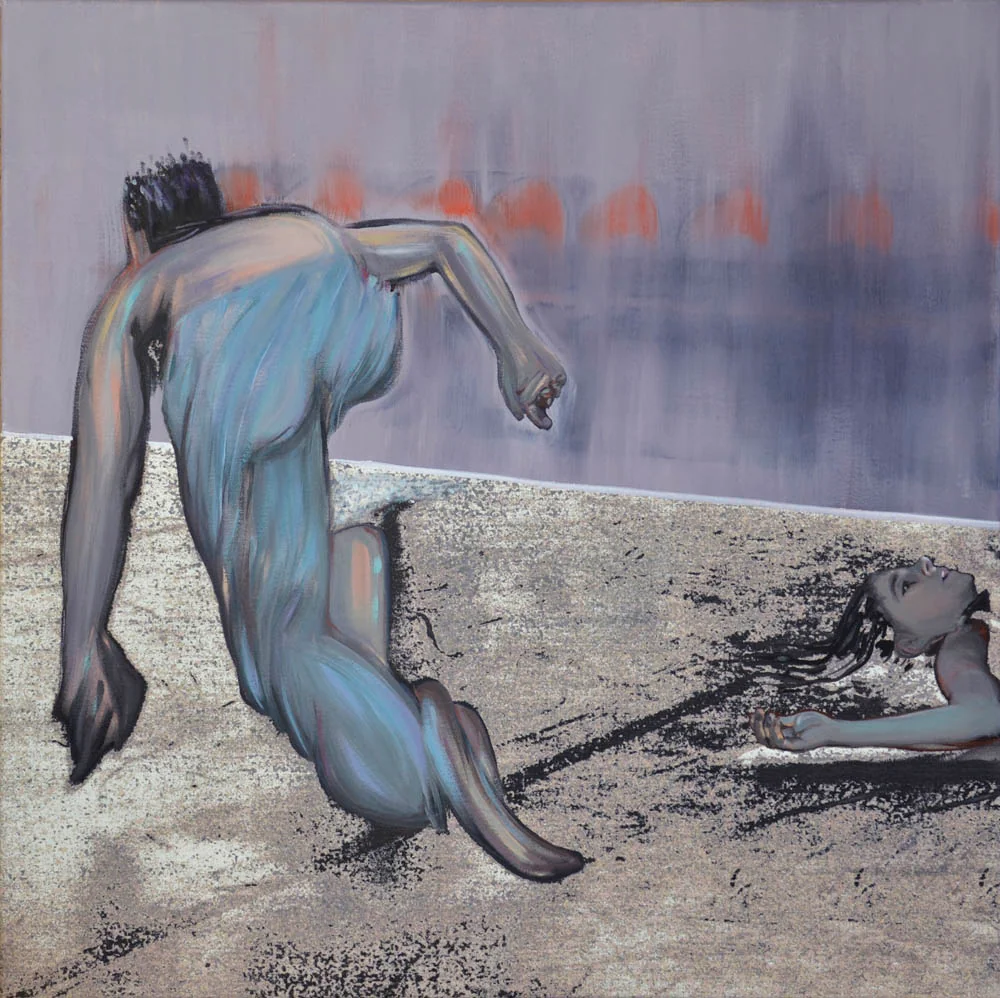
Untitled
55 × 55, oil, canvas, print, 2016
The Godot Gallery warmly invites you.
Csurka Eszter
Aura
for the exhibition titled
Opening: 2016 on 5 May at 20
Opening: Kincses Károly, museologist, photographic historian.
Available: from May 6-8 daily between 10 and 18 o’clock.
The exhibition, in an unusual manner, will be available for only three days. Within the auction to take place on 7 at 18 at the Danubius Hotel Gellért, two works from the exhibition will be auctioned.
The exhibition is held as part of the Eleven Design Weekend, in connection with the 1 Artist 1 Porta project.
In a larger size
Untitled
55x55, oil, canvas, print, 2016
With the spread of photography and the use of long exposure times, a serendipitous possibility arose for the movement of people and machines to be represented in some way. Drawing on the first images initially deemed merely poor photographs, the futurists introduced the first wave of portraying dynamism. In futurist images the composition is created through the division of the original sight into planes, then rearranging them anew, while their philosophical outlook was partly given by the industrial age and faith in progress. The futurist myth, however, proved unfounded after the first world war, at least it became profoundly questionable.
The central motif in Eszter Csurka’s visual language is also movement. Her painting *Balla Pórázon vezetett kutya* (Dog Leashed on a Balla) or the plastic of *Boccioni A térbeli folytonosság egyesített formái* (Boccioni One Form of Spatial Continuity) can be seen as unequivocally related to Csurka’s work in terms of visuality. Yet – and this is critically important – there is no longer that optimism (which, in hindsight, might even be called naïveté) that was so decisive in early twentieth‑century modernist painting. Fragmentation no longer coalesces into a coherent semantic whole; it remains in a disjointed state. The motif of movement cannot be equated with forward progress either; rather, it tends toward references to falling or plunging, although the dynamism of the images is undeniable.
In larger size
Untitled
55 × 55, oil, canvas, print, 2016
The careless treatment, in many cases reduced to a mere background reference on expansive planes, and the transparent figures that link those planes can be likened to some images by Martin Kippenberger. However, in Eszter Csurka’s works, the fine brushwork and restrained use of colour are complementary to the unique character and special atmosphere of the pieces, especially in contrast to Kippenberger’s harsh colour use and his shift toward the grotesque.
The feeling can attack us like when we stare at a ripped‑out frame from a film – continuity breaks and space is created between signifier and meaning. The filmic quality of the images is further amplified by the grain that appears in them, which is a feature of analogue image‑making technology, in contrast to the pixel, the basic unit of digital photography. The surprising point is that Csurka Eszter develops her images from digital photographs and their manipulation in Photoshop, yet we see grain, not pixels, in her work. Starting from this grain and through analogue photography and Susan Sontag’s cutting‑edge essay, *On Photography*, we arrive at the concept of the aura described by Benjamin, where a paradox emerges: Csurka Eszter’s alienated memories belong to an accelerated world, yet they possess an aura. Part of the power of the images is owed to this contradiction and to her remarkably exact compositional technique. – Retteghy Ádám, aesthete
In larger size
Without a title
55 by 55, oil, canvas, print, 2016