Ádám Zoltán, Aatóth Franyó, Bada Dada Tibor, Bukta Imre, drMáriás, efZámbó István, El Kazovszkij, feLugossy László, Fehér László, Gerhes Gábor, Mulasics László, Nádler István, Nagy Kriszta x-T, Soós Nóra, Swierkiewicz Róbert, Szirtes János, Tarr Hajnalka, Várnai Gyula, Wahorn András
Kortárs magángyűjtemények XVII. – Gerendai Károly gyűjteménye
- Dates
- 25 April 2012 – 26 May 2012
- Venue
- Godot Galéria · 1114 Budapest, Bartók Béla út 11–13.
- Press contact
- [email protected]
Short listing
Nagyobb méret
Full exhibition text
Larger size
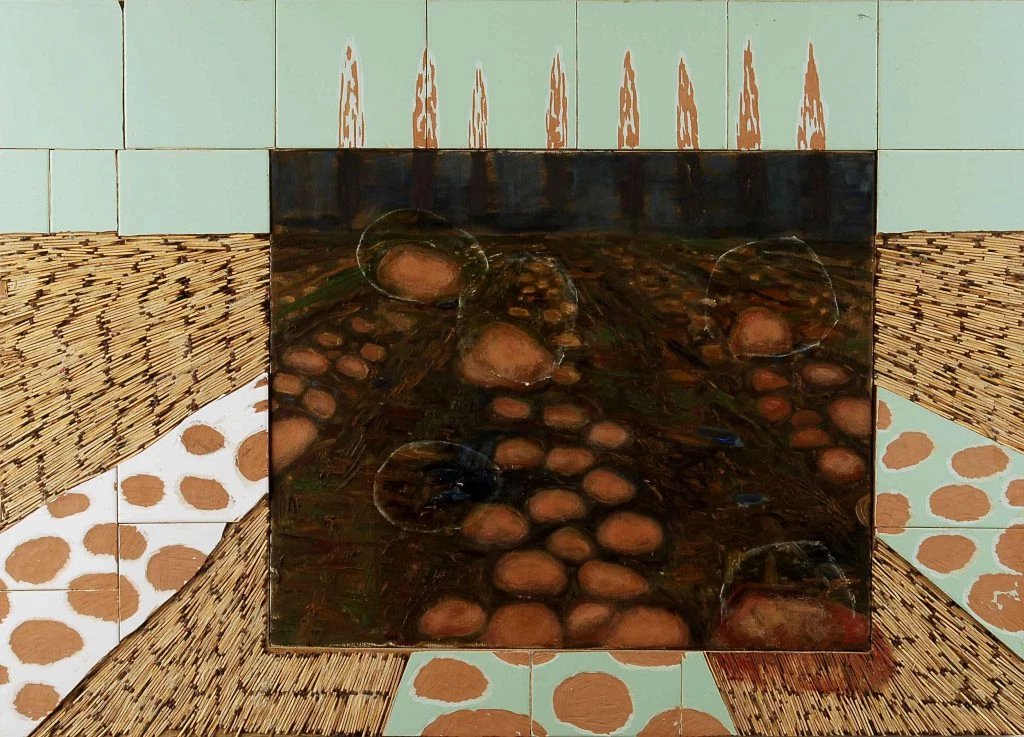
Bukta Imre: Giant Potatoes at the Border
74×103, oil, canvas, tile and match on a wooden board, 2001
The Godot Gallery warmly invites you to the
Contemporary self‑collection Bilancio…
for the exhibition titled __, which this time presents a selection from the collection of Károly Gerendai.
feLugossy László: Black Box
70 × 100, charcoal, paper, 1997
The exhibiting artists: Ádám Zoltán, Aatóth Franyó, Bada Dada Tibor, Bukta Imre, drMáriás, efZámbó István, El Kazovszkij, feLugossy László, Fehér László, Gerhes Gábor, Mulasics László, Nádler István, Nagy Kriszta x‑T, Soós Nóra, Swierkiewicz Róbert, Szirtes János, Tarr Hajnalka, Várnai Gyula, Wahorn András
Opening: 2012. April 25 at 20 o'clock.
Opening: Dr Máriás
Curator: Zsuzsanna Stánitz
Open to the public until May 26
Francoise Gilot: A blasphemy on the Nile
34 × 24, acrylic, canvas, 1998
"Something must have started with music – one might think, if the discussion turned to Károly Gerendai’s private collection. When looking at a collection of more than 200 works of visual art, the list of artists who, through their work, fundamentally shape the medium and mirror the collector’s attitude becomes unmistakably outlined. Gerendai himself puts it this way: “I have the same obsessive and fundamentally emotional attachment to visual art as I do to the other hobbies of my life. From the very first moment, music has mainly determined whom I got photographs from” – our hypothesis, therefore, is confirmed. The passion for music laid the foundation for another commitment – the collection of works of visual art.
Collecting works of art can easily become an addiction, with the “entry card” being the decisive and crucial point – once the process starts, there is no turning back. Nothing illustrates this more clearly than the fact that neither at the Sziget office nor at Gerenda’s private home can one find an empty wall – the collector spends his days among the works and gladly shares this joy with his colleagues. Consider the musical background of that certain “entry card”, and it becomes obvious why the works of EfZámbó István, FelLugossy László, and Wahorn András form one of the defining circles of the collection. Yet this was only the beginning of a collector’s gradual immersion in contemporary art; the palette has since expanded and brightened remarkably. Collecting is at the same time a learning process, and as a result a distinct, maturing body of material has now been assembled on a basis of independent decisions. In his early choices a decisive role was played by the advisory and then friendly relationship established with gallery owners, a relationship that still characterises the collector today, though investment considerations still do not occupy him. Thus art buying is set in motion by emotional aspects, coupled with an increasingly informed and artist‑savvy collecting attitude.
András Wahorn: Man with Knife
160 times 190, oil, canvas, 1997
The collection’s most prominent line is therefore not formed by the light work of former musicians who later turned to art in a self‑taught manner (efZámbó, feLugossy, Wahorn). It also includes Aatóth Franyó’s works, which, together with the earlier Szentendre group, give the collection a somewhat absurd, dream‑like, figurative section that deals mainly with human dilemmas. Another key line is represented by more abstract, gesture‑based pieces that play with material handling and surface. Gerendai owns several works by Ádám Zoltán, Nádler István, Bukta Imrét, Fehér László, Mulasics László, Swierkiewicz Róbert and Szirtes János, whose successive, varied stylistic periods are clearly traceable. Thus the collection’s two main thrusts are based on the two groups already described, complemented by works of artists whose style is sometimes child‑like but whose subject matter is decidedly different, such as the works of Dr Máriás Béla, Bada Dada or Nagy Kriszta, or the paintings of Soós Nóra, whose fine politically‑oriented piece “Sivatagi Róka” is also on display. The traditional painting medium gradually loosens into more experimental media, such as Gerhes Gábor’s lightbox piece or Várnai Tibor’s lens‑lenticular landscapes. The younger generation is represented by Soós Nóra, Csiszér Zsuzsi’s montage‑style images and Győri Márton’s vividly coloured, sometimes figurative, sometimes abstract canvases, and there are also significant works from several periods of Tarr Hajnalka in the collection. The collection, dominated by Hungarian artists, is rounded out by Jurriaan Molenaar’s clean architectural paintings, Francoise Gilot’s abstract works and Martin C. Herbst’s monumental portraits.
The selection on view in the Godot Gallery is a curation based on the highly complex, eclectic collection’s curatorial work, whose aim is to showcase the segments that form the backbone of the collection and, at the same time, forecast its expanding spectrum.
Stánitz Zsuzsanna
Nádler István: Black Bus No.2
140 × 110, oil, canvas, 2007