Csáji Attila, Frey Krisztián, Galántai György, Gyarmathy Tihamér, Hencze Tamás, Jovián György, Korniss Dezső, Lévay Jenő, Molnár Sándor, Nagy Kriszta x-T, Regős Imre, Stuiber Zsuzsa, Šwierkiewitz Róbert, Tandori Dezső, Ujházi Péter, Xertox Csoport és MAIL ART, Zoltán Sándor
Kortárs magángyűjtemények XV. – Sáránszki Péter gyűjteménye
- Dates
- 26 May 2010 – 19 June 2010
- Venue
- Godot Galéria · 1114 Budapest, Bartók Béla út 11–13.
- Press contact
- [email protected]
Short listing
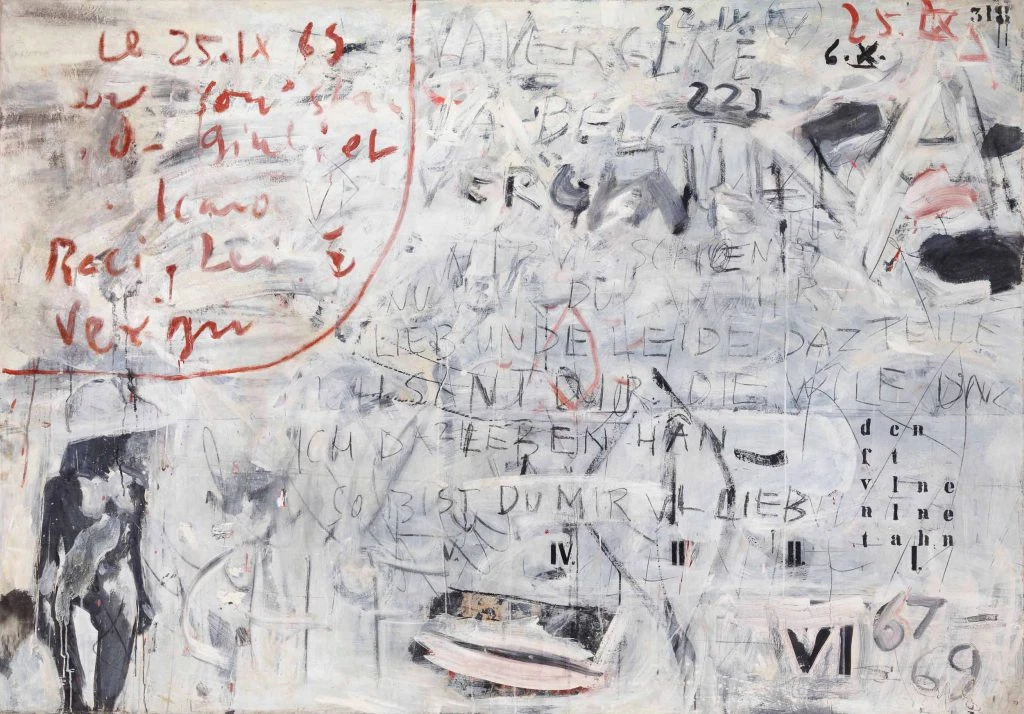
Frey Krisztián: La Vergine 1967-69
Full exhibition text
Frey Krisztián: La Vergine 1967-69
The Godot Gallery warmly invites you and your partner to
Contemporary Self-Collections XV.
for the exhibition titled ___, where this time we are presenting a selection from the collection of Péter Sáránszki.
Artists on display: Csáji Attila, Frey Krisztián, Galántai György, Gyarmathy Tihamér, Hencze Tamás, Jovián György, Korniss Dezső, Lévay Jenő, Molnár Sándor, Nagy Kriszta x‑T, Regős Imre, Stuiber Zsuzsa, Šwierkiewitz Róbert, Tandori Dezső, Ujházi Péter, Xertox Csoport and MAIL ART. Opening by: Zoltán Sándor. 2010 on 26 May at 20 o’clock.
Viewable: until June 19
Sándor Molnár: Metamorphosis 1975
Since 2001, the Godot Gallery has been organising exhibitions that pick works from celebrated private collections of contemporary art around particular themes. The importance and timeliness of our series is also shown by the Art Fanatics – Contemporary private collections 2 presently running at the Műcsarnok, and by the exhibition titled Kortárs magángyűjtemények 1 arranged one and a half years earlier, which presented four collections that had previously appeared on the walls of the Godot Gallery (Somlói‑Spengler Collection, Antal‑Lusztig Collection, Feuer Collection, Barabás Collection).
The current exhibition’s material has been curated from the collection of a young, ambitious collector, Péter Sáránszki. Despite a history of only a few years, the collection spans several generations and manifests itself in multiple directions. For him collecting is a vocation, so his choices demonstrate an individual sense of quality. The deepening of emphasis is a conscious decision; a shared spirit with the artists is important. Our current selection has focused primarily on works that stem from conceptual art or are “write‑in” images – that is, pieces in which writing or handwriting plays a significant functional, content, or decorative role. Let us highlight a few of these points.
The Sáránszki Collection houses the emblematic work *I am a Contemporary Painter, Nagy Kriszta x‑T*, which the artist created in 1998, but the waves of controversy it sparked have not died down to this day. At the time it was regarded as a revolutionary act when the artist, adopting the trappings of lingerie advertising, posed on the Lövölde Square giant poster, laying bare herself, her own art and the whole of domestic contemporary art before the market economy’s real or perceived expectations and demands, and raising countless questions that had until then been taboo in the visual‑arts world.
Nagy Kriszta x‑T: I am a contemporary painter 1998
At the gallery the Xertox Group’s photographic paper roll will be on display – it was the product of a 1982 performance‑meditation: the group’s members and other participants at the opening stood against the wall in front of the light‑sensitive paper, thereby capturing the participants’ contours and imprint. The material had formed part of the international mail‑art exhibition entitled “Emberkísérletek” at the Pesterzsébeti Museum, and at that time it was banned and the exhibition closed.
Xertox Group: Human Experiments – performance 1982
Some pieces of Robert Šwierkiewicz’s Self‑Expanding Mail Art Project will also be on display, together with the book on the project that was published this year. In 1981 the artist sent 88 cardboard hole‑cards, written on cardboard, to artists well known both internationally and domestically, and received the same number back by post, processed by the artists according to their own intuition, mood and direction. Thus Šwierkiewicz’s work, and the gesture of the artists who responded to it, became one of the defining stages of the domestic mail art movement.
Šwierkiewicz Róbert: Cummings artwork 41 /detail/ 1981