feLugossy László
feLugossy László: Spontán válogatás - 2017-01-20 — 2017-02-11 - Godot Galéria
- Dates
- 20 January 2017 – 11 February 2017
- Venue
- Godot Galéria · 1114 Budapest, Bartók Béla út 11–13.
- Press contact
- [email protected]
Short listing
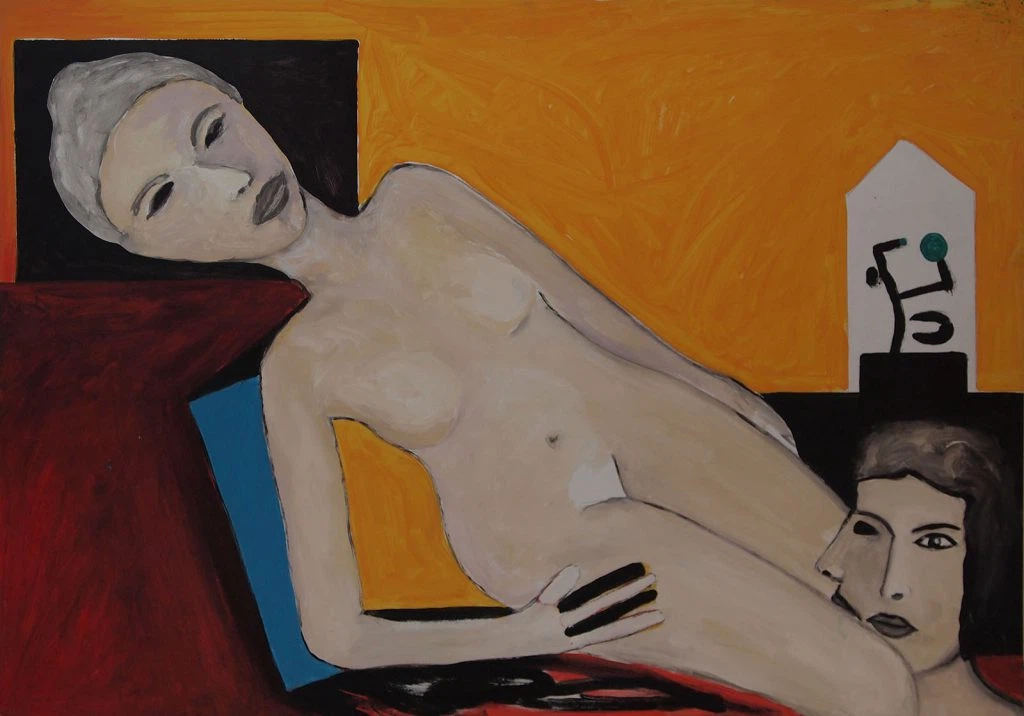
Akt kíváncsiskodókkal 70×100, akril, farost, 2011
Full exhibition text
Nude with curious ones 70 × 100, acrylic, oil, 2011
László feLugossy
SPONTANEOUS SELECTION (1999-2017)
Opening: 2017 January 20 at 19
Opening: feLugossy from Afar.
Open to view until February 11 from Tuesday to Friday from 9 to 14, on Saturday from 10 to 13.
5/6‑th water wringer, 100 × 70, acrylic, cardboard, 2005
Total Presence
There are moments when the harmony between being present and staying elsewhere can convey a perfect, profound meaning if we sensibly set aside the source, the common denominator. Substantial quantities in the dizzying ratio of qualities. Could I be so abstract that I represent my physical presence in a different, and even clumsy, way?
(For the desire of faithful attendance)
The Godot Gallery has existed since 1999. Therefore, with one of the gallery's most important artists, we have agreed to handpick 19 works from him over the last 19 years. These can be viewed now.
Lesson 80 × 120, charcoal, paper, 2001.
At first he studied photography. In addition to visual art he also works with film, literature and music. He is the founder of the Vajda Lajos Studio in Szentendre, between 1980 and 1986 he was a member of the A.E. Committee’s band. He created the Inkaszámtan incidental troupe (1983), together with friends he formed the New Modern Acrobatics music‑performance (1985–1992) and the Batu Kármen band. He has been involved in visual art since the age of 17. In the middle of the 60s in Kecskemét he and Zámbó István founded a club where they organised exhibitions, literary evenings, beat concerts and also took part in them. At that time the idea of the Szentendre outdoor exhibitions that ran from 1968 to 1977 was born. During his early years in Kecskemét his work was heavily influenced by Tóth Menyhart’s painting. Since the early 70s he exhibits regularly. He expanded his concepts of modern art by experimenting with instinctive artistic expressions. Using collage technique he draws, paints, applies photographs, creates video films, and also writes poetic texts. In his work the visual artistic expression intertwines closely with poetry, music and all kinds of creative activity. In his early experimental period the most defining feature of his creative activity became free, natural and spontaneous expression. His visual imagination and ideas are so rich that his work cannot be separated into distinct eras; at most, from a technical point of view we can talk about certain image cycles (The Fine series, Identical Beings, the various Sufferings series). He is a typical representative of the East‑European underground avant‑garde, striving to create a new type of art object in perception, quality and presentation. He often works in a simplified, neo‑primitive style, but his artistic experiments that break through conventional genre boundaries also include choral poetry, raw‑meat compositions, happenings, performances, ready‑made objects, artefacts, environments and other facets of his diversity. In his style the direct object cult of pop art often mixes with the stark, sexual symbol system of graffiti. In Hungarian art he presents – with singular honesty, free from any illusion or self‑importance – the most obvious things, which are a characteristic of the most realistically existing, regressive East‑European societies today. This is the distinctly earthy peasant and petty‑bourgeois world, a mixture of emptied folklore and second‑class modernity, from which he builds a unique, association‑rich universe (Constitutionary Scene, International Dying). Instead of creating a unique work he aims to show the fleeting power of objects. In the banal objects of the ruined suburban environment – the domestic animals, the kitchen, the nylon mower, the cold‑crackling neon tube, the ripped foil, the brand‑new shiny aluminium water bucket, etc. – in the eclectic patchwork of remnants he seeks ancient, archaic values. From the trash of everyday life he creates ritualised everyday situations in the pattern of third‑world cult‑mythic associations. In his art the associations of material heritage can be read both as myth and counter‑myth. The mingling of symbols and banalities, the neglected vulgarity and the vagrant extolment are presented unflinchingly and yet lovingly, loosely, summery and accepting. Unlike the Dadaist studio, Tristan Tzar, and Marcel Duchamp, he does not intend to provoke but to impact, when he makes the invisible dimensions of life visible. – artportal.hu
Self‑portrait with spatula 60×50, acrylic, canvas, wood, 2015
www.offjövő.hu
70 x 100, oil, canvas 1999