- Dates
- 30 October 2012 – 8 December 2012
- Venue
- Godot Galéria · 1114 Budapest, Bartók Béla út 11–13.
- Press contact
- [email protected]
Short listing
A Godot Galéria meghívja Önt Bukta Imre kiállítására. A kiállítás 2012. október 30 és december 8 között tekinthető meg a galéria nyitva tartási idejében: keddtől péntekig 9 és 14 óra, szombaton 10 és 13 óra között. Szünnap hétfő, vasárnap és ünnepnap.
Full exhibition text
A Godot Gallery invites you to visit the exhibition by Imre Bukta. The exhibition is open from 2012 October 30 to December 8, within the gallery’s opening hours: from Tuesday to Friday 9 to 14 o’clock, and on Saturday from 10 to 13 o’clock. It remains closed on Mondays, Sundays and public holidays.
Since 2005 Bukta Imre has been a resident artist at the Godot Gallery, he has been exhibiting his current, latest works in our gallery every two years. The next exhibition had been slated for 2013, but we have brought it forward to this point. The reason is that from November, the Műcsarnok will be organising a show for the artist across the whole of its premises for three months. Thus we decided to honour this unconventional display with the 60‑year‑old creator this year. The show will present a subjective selection of his paintings from the previous ten years, his paper works and his photographs.
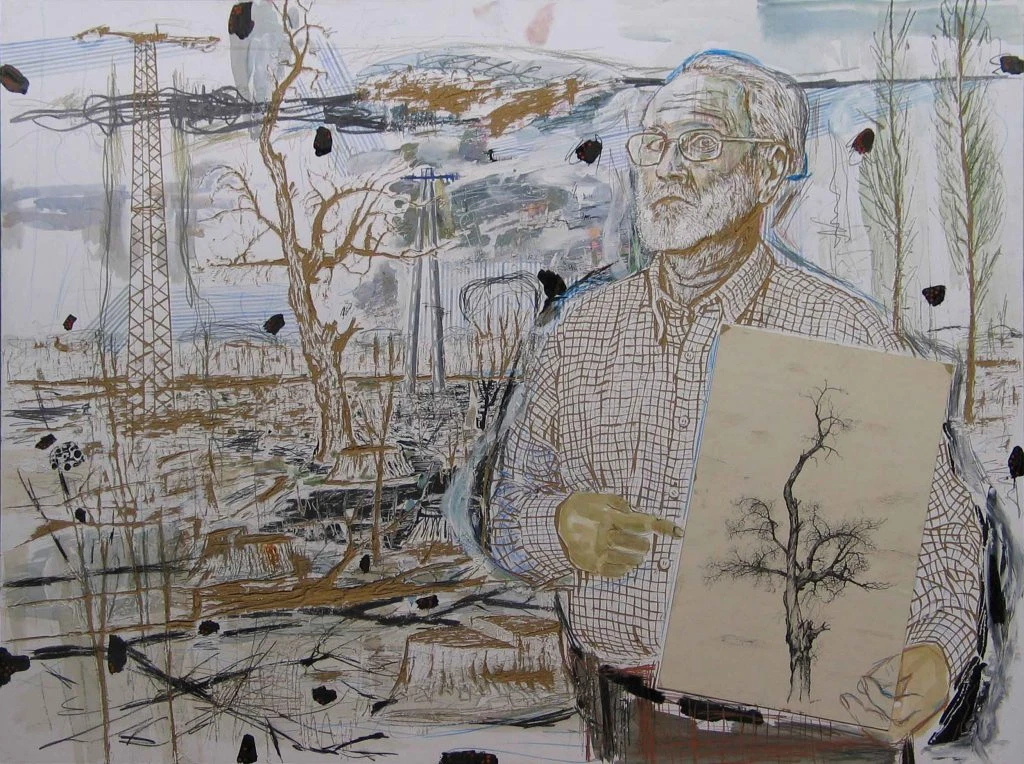
Self‑Portrait
copperplate, watercolour, pastel, pen on paper and on wood panel, 2012
Imre Bukta is one of the most original creators in contemporary Hungarian visual art: a graphic designer, painter, performer, sculptor, photographer and teacher. His career began as a self‑taught artist in the 1970s. His work is closely tied to the lifestyle and culture of Hungarian people who live in the countryside and work in agriculture. From the outset his subjects are drawn from the everyday objects, places and people of a hard, working life, and he uses a range of tools to depict them: in his paintings he freely employs any natural material that falls into his hands—fur, wood, corn, tiles, matchsticks, and the like—which he assembles in an assemblage‑like fashion. In his objects, installations and performances he places the everyday implements of peasant material culture side by side in a self‑evident way, or constructs from them unique machine‑image structures. His portraits and compositions can be read as special sociological studies, but while an outsider and detached analyst might look at them, Bukta sees and portrays this peculiar, sweet‑bitter world from within. His perception is at times ironic, at times melancholic, at other moments (in society) critical or indulgent, yet he always approaches his subjects with exceptional empathy.
Courtyard scene
oil, canvas, 2009
For four decades her art has been consistently celebrated, and is held in a variety of domestic and foreign public and private collections. She has twice represented Hungary at the prestigious Venice Biennale (1988, 1999), and three books have been published about her (Új Művészet Kiadó 1998, A38 Kht 2006, MODEM 2008). She is also a teacher at the Eszterházy Károly College in Eger and at the Academy of Fine Arts.
Floating cow
gelatin silver print, 2003
After 1998 he returned to his parents’ hometown, Mezőszemerére, his interest gradually turned towards painting. A kind of stylistic classicisation can be seen in these works: their subjects increasingly approach traditional painting genres such as genre painting, interior painting, portrait and landscape. The decorative quality of the “bump” surface‑filling motifs (plastering, rendering, net pattern, etc.) becomes more pronounced and comes to life independent of the composition.
In 2011 he presented large‑scale, paper‑based paintings to the public, which, on the one hand, synthesise the “thread‑ing” fields used in the 80s, and, on the other, the finer surface‑treatment works of the 90s. The pieces in the series embrace the world of pastels instead of heavy oils; Bukta, however, proliferates across the tools – ink, graphite, tempera, watercolour, charcoal – so that from a distance the works appear collage‑like and evoke the scene of applications he had previously employed. With the series he continues to build the rural landscape that he portrays with consistent loyalty and coherence, and at the same time offers a way out to the viewer; for him it has worked to create, even in this austere wilderness, a studio, a mood, a family and a circle of friends where anyone can feel at home.
Róza and Lőrinc
oil, canvas, 2009